Sunday, 14 November 2021

Universities vs Elsevier: who has the upper hand?


The academic publisher Elsevier is currently negotiating a deal with UK universities. In Oxford, as in other universities, there have been extensive discussions about the proposed deal; the goals are to reduce costs to sustainable levels and to provide full and immediate open access to UK research. I have a nasty feeling that we could end up in the situation of those at the COP summit: with a deal that where the publishers feel they are giving away a huge amount, while the consumers are still unsatisfied. 

In the print era, publishers already had a large profit margin.  I was a journal editor when electronic publishing first came in, and I remember discussions with the publisher - who was clearly very nervous about how this might damage their bottom line. With some clever business practices, such as bundling, they managed to keep going, making more rather than less money.

Other new developments - the advance of metrics and requirements for open access publishing - also pose challenges to them, but their response, like any savvy business, is to take control of these new developments and find a way to profit from them as well.

So should we go along with this? The discussions have largely centred around money, and this is a real concern. Publishers charge massively inflated subscription charges, taking as profit money that our libraries could otherwise put to good use. But the problems go way beyond that, including blocking open access to authors' own work, and giving poor quality and even fraudulent material a veneer of respectability. The publisher currently has considerable power over what gets published but takes little responsibility when things go wrong.

But we also have power, and I think it's time we started to wield it. I have two proposals: one radical and the other less so, both of which go beyond what is currently being considered in the JISC discussions.

The radical option: move publishing in-house  

In an ideal world, we would not have any deals with for-profit publishers. Universities would take control of academic publishing. A model which I have found works well is the Wellcome Trust journal Wellcome Open Research (WOR). I served on its Editorial Advisory Board in the first years of its operation and I have published eight papers in WOR. 

Quality control is maintained by requiring that work published in WOR has been Wellcome-Trust funded. The platform is paid for by the Wellcome Trust, and all material is Open Access, with no charge to authors.

Universities could use this as a model for developing their own platforms for publishing work of their researchers. As with Wellcome Trust, researchers would be encouraged rather than required to publish there. Setting up and maintaining the platform would cost money, but this might be covered by savings from stepping back from deals with big publishers. This is not a perfect solution, of course; we would still want access to past material published by traditional publishers. But I feel this option should be given serious consideration.

The less radical option. An agreement with Elsevier that reflects what we want and need 

If we are to retain a working relationship with Elsevier, then we need to ensure that we are getting value for money, and that they are delivering what we want.

One way in which they fail to do this is through the copyright agreements that they require authors to sign. I agree with Sally Rumsey that any publisher that does not allow an author to retain rights to their own work is problematic. Furthermore, there is concern that even if Elsevier were to say they agreed to author rights retention, they would continue to adopt practices that would mislead authors into signing away their rights.

Another issue is how publishers deal with matters related to misbehaviour by editors and authors. We have a number of serious problems with the academic publishing system that have been developing for years, and have been thrown into stark relief by the pandemic. Publications in journals are a kind of academic currency, with potentially huge rewards in terms of promotion, pay and tenure of academic staff. Unfortunately, this means that some people will go to great lengths to procure publications, and this can include fraudulent means. A reputable publisher should recognise and indeed anticipate such problems and take steps to deal with them. Elsevier has been notably poor in doing so. I will give a handful of examples.

Clearly erroneous/fraudulent work remains in the literature In recent years, a massive problem has been discovered with so-called paper mills - a form of industrialised cheating that involves generation of literally thousands of fake papers.  This phenomenon was discussed at a meeting this summer, the Computational Research Integrity Conference (CRI-Conf), which brought together some of the scientists who uncovered paper mills and representatives of publishers (including Elsevier) and university integrity officers. A repeated complaint of the 'data sleuths' (scientists who uncovered the paper mills) was that when the problems were drawn to the attention of the editors or publishers, typically nothing was done.  Some of these papers are highly cited and have medical implications - see, for instance work by Jennifer Byrne and Cyril Labbé on cancer biology, or by Elisabeth Bik on image manipulations.

To its credit, Elsevier was recently cited as acting promptly when a cache of nonsense papers in special issues was uncovered, but one still has to ask how these papers, some of which were complete gibberish, originally got through the supposedly rigorous peer-review process. For another recent example, see here.

Part of the problem seems to be that there is very little oversight of editors.  I first became aware of Elsevier's lax attitude to research integrity when I discovered a ring of editors. There was overwhelming evidence that a set of editors were publishing one another's papers in their journals, with publication lags so brief as to indicate there had not been peer review. Emails to Elsevier received no reply, and so I started reporting the events on my blog. This created such publicity that Elsevier then posted a reply, but initially they denied that any papers had been published without peer review. Eventually, as the evidence mounted up, they were forced to acknowledge the problem, and claimed to be investigating it, but at no point did they communicate with me, and their investigation went on for years and has never led to any consequences. One of the offending editors, Johnny Matson, quietly disappeared without comment and is now editing another journal for another publisher. The unreviewed papers, many of which are concerned with intervention for children with developmental disorders, remain in the literature. 

More recently I did a bibliometric analysis of editors of psychology journals who publish prolifically in their own journals, and broke down the results by publisher. Elsevier had the highest number of editors-in-chief in this category,

A related case in another field is that of Didier Raoult, who was senior author on a paper advocating hydroxychloroquine as a treatment for Covid-19 that appeared in 2020 in an Elsevier journal for which he was Editor-in-Chief. It has subsequently been shown to be riddled with methodological errors, but, although Elsevier claimed to be investigating it in April 2020, it has not been retracted.

At the CRI-Conf publishers said that they were doing their best, but the problem of fake and fraudulent practices was so huge they could not be expected to tackle all of it. Yet we know publishers make enormous profits, so why aren't they putting more effort into checking the integrity of the work they publish - and dealing promptly with the problems that are drawn to their attention? Elsevier is not the only large publisher to be affected, but if it wants to be seen as a leader in the field, it should recognise that integrity of published material is of supreme importance - especially in clinical fields where people's health and wellbeing can be affected (as in the cases of Raoult and Matson noted above).

If UK Universities do strike a deal with Elsevier, then they should take the opportunity to include in any future contract conditions requirements that: 

(a) Elsevier allows authors the retention of the rights to their publications and  

(b) it provides annually an open report on the number of integrity issues that have been raised about its publications and how these have been dealt with. 

This would go some way toward ensuring that we get value for money, and are not simply adding to the profits of a company whose underlying ethos is not aligned with promoting scientific quality.

Universities have historically been extremely meek in accepting the terms and conditions imposed by big publishers, who have in turn treated academics as a cash cow. We on the one hand produce for free the product that they sell, and then pay to publish and read it. They cannot survive without the research created in Universities: we should start recognising that we need not bow down to their demands.

DISCLAIMER: I am writing in a personal capacity and not as a representative of the University of Oxford.


14/11/21

P.S. Some further examples of integrity problems with Elsevier have been pointed out to me on Twitter:

Geoff Frampton (@Geoff_Frampton) noted 'Elsevier had the largest market share among the publishers of retracted Covid-19 articles in our study' 

Patricia Murray (@PMurray_65) tweeted: Elsevier have failed to retract this 2008 Lancet paper that is known to be fraudulent and poses a risk to patients: thelancet.com/journals/lance The paper stated the so-called 'bioengineered' airway had "a normal appearance and mechanical properties at 4 months." 

It is particularly shocking that the publisher is still making this article available (at a cost of $31) given that the author had a prison sentence for faked research, and conducted unethical experiments on seriously ill patients: see this report. 

PPS - it gets worse. There have been strenuous attempts to get the journal to retract the paper, to no avail. This has made the national news in the UK.


Comments on this blog are welcome, but may only appear after a delay as they are moderated to avoid spam. 


Saturday, 27 March 2021

Open data: We know what's needed - now let's make it happen

©Cartoonstock.com


The week after then end of University term and before the Easter break is choc-a-bloc with conferences and meetings. A great thing about them all being virtual is that you can go to far more. My brain is zinging (and my to-do list sadly neglected) after 3 days of the Computational Research Integrity Conference (CRI-Conf) hosted at Syracuse University, and then a 1.5 hr webinar organised by the Center for Biomedical Research Transparency (CBMRT) on Accelerating Science in the Age of COVID-19. Synthesising all the discussion in my head gives one clear message: we need to get a grip on failure of authors to make their data, and analysis scripts, open. 

For a great overview of CRI-Conf, see this blog by one of the presenters, Debora Weber-Wulff . The meeting focused mainly on fraud, and the development of computational methods to detect it, with most emphasis on doctored images. There were presentations by those who detect manipulated data (notably Elisabeth Bik and Jennifer Byrne), by technology experts developing means of automating image analysis, publishers and research integrity officers who attempt to deal with the problem, and by those who have created less conventional means to counteract the tide of dodgy work (Boris Barbour from PubPeer, and Ivan Oransky from Retraction Watch). The shocking thing was the discovery that fabricated data in the literature is not down to a few bad apples: there are "paper mills" that generate papers for sale, which are readily snapped up by those who need them for professional advancement.

CRI-Conf brought together people who viewed the problem from very different perspectives, with a definite tension between those representing "the system" - publishers, institutions and funders - and those on the outside - the data sleuths, PubPeer, Retraction Watch. The latter are impatient at the failure of the system to act promptly to remove fraudulent papers from the literature; the former respond that they are doing a lot already, but the problem is immense and due process must be followed. There was, however, one point of agreement. Life would be easier for all of us if data were routinely published with papers. Research integrity officers in particular noted that a great deal of time in investigations is spent tracking down data.

The CBMRT webinar yesterday was particularly focused on the immense amount of research that has been generated by the COVID-19 pandemic. Ida Sim from Vivli noted that only 70 of 924 authors of COVID-19 clinical trials agreed to share their data within 6 months. John Inglis, co-founder of biorXiv and medrXiv cited Marty Lakary's summary of preprints: "a great disruptor of a clunky, slow system never designed for a pandemic". Deborah Dixon from Oxford University Press noted how open science assumed particular importance in the pandemic: open data not only make it possible to check a study's findings, but also can be used fruitfully as secondary data for new analyses. Finally, a clinician's perspective was provided by Sandra Petty. Her view is that there are too many small underpowered studies: we need large collaborative trials. My favourite quote: "Noise from smaller studies rapidly released to the public domain can create a public health issue in itself".

Everyone agreed that open data could be a game-changer, but clearly it was still the exception rather than the rule. I asked whether it should be made mandatory, not just for journal articles but also for preprints. The replies were not encouraging. Ida Sim, who understands the issues around data-sharing better than most, noted that there were numerous barriers - there may be legal hurdles to overcome, and those doing trials may not have the expertise, let alone the time, to get their data into appropriate format. John Inglis noted it would be difficult for moderators of preprint servers to implement a data-sharing requirement for pre-prints, and that many authors would find it challenging.

I am not, however, convinced. It's clear that there is a tsunami of research on COVID-19, much of it of very poor quality. This is creating problems for journals, reviewers, and for readers, who have to sift through a mountain of papers to try and extract a signal from the noise. Setting the bar for publication - or indeed pre-prints - higher, so that the literature only contains papers that can be (a) checked and (b) used for meta-analysis and secondary studies, would reduce the mountain to a hillock and allow us to focus on the serious stuff. 

The pandemic has indeed accelerated the pace of research, but things done in a hurry are more likely to contain errors, so it is more important than ever to be able to check findings, rather than just trusting authors to get it right. I'm thinking of the recent example where an apparent excess of COVID-19 in toddlers was found to be due to restricting age to a 2-digit number, so someone aged 102 would be listed as a 2-year-old.  We may be aghast, but I feel "there but for the grace of God go I". Unintentional errors are everywhere, and when the stakes are as high as they are now, we need to be able to check and double-check findings studies that are going to translated into clinical practice. That means sharing analysis code as well as data. As Philip Stark memorably said, "Science should be 'show me', not 'trust me'".

All in all, my sense is that we still have a long way to go before we shift the balance in publishing from a focus on the needs of authors (to get papers out rapidly) to an emphasis on users of research, for whom the integrity of the science is paramount. As Besançon et al put it: Open Science saves lives.

Saturday, 13 March 2021

Time for publishers to consider the rights of readers as well as authors


© cartoonstock.com
I've just been reading this piece entitled: "Publication ethics: Barriers in resolving figure corrections" by Lataisia Jones, on the website of the American Society for Microbiology, which publishes several journals.  Microbiology is a long way from my expertise and interests, but I have been following the work of Elisabeth Bik, datasleuth extraordinaire, for some time - see here. As Bik points out, the responses (or more often lack of response) she gets when she raises concerns about papers are similar to those seen in other fields where whistleblowers try to flag up errors  (e.g. this Australian example). 

It's clear that there are barriers to correcting the scientific record when errors are identified, and so I was pleased to see a piece tackling this head-on, which attempts to explain why responses by journals and publishers often appear to be so slow and unsatisfactory. However, I felt the post, missed some key points that need to be taken seriously by publishers and editors. 

The post starts by saying that: "Most figure concerns are created out of error and may present themselves in the form of image duplication, splicing and various figure enhancements." I think we need to have that "most" clarified in the form of a percentage. Yes, of course, we all make mistakes, but many of the issues flagged up by Bik are not the kinds of error made by someone going "oops" as they prepare their figures. I felt that on the one hand it is crucial to be aware that many papers are flawed because they contain honest errors, but that fact should not lead us to conclude that most cases of problematic images are of this kind. At least, not until there is hard evidence on that point. 

The post goes on to document the stages that are gone through when an error has been flagged up, noting in particular these guidelines produced by the Committee on Publication Ethics (COPE). First, the author is contacted. "Since human error is a common reason behind published figure concerns, ASM remains mindful and vigilant while investigating to prevent unnecessarily tarnishing a researcher’s reputation. Oftentimes, the concern does not proceed past the authors, who tend to be extremely responsive." So here again, Jones emphasises human error as a "common reason" for mistakes in figures, and also describes authors as "extremely responsive". And here again, I suggest some stastistics on both points would be of considerable interest. 

Jones explains that this preliminary step may take a long time when several years have elapsed between publication and the flagging up of concerns. The authors may be hard to contact, and the data may no longer be available. Assuming the authors give a satisfactory response, what happens next depends on whether the error can be corrected without changing the basic results or conclusions. If so, then a Correction is published. Interestingly, Jones says nothing about what happens if an honest error does change the basic results or conclusions. I think many readers would agree that in that case there should be a retraction, but I sense a reluctance to accept that, perhaps because Jones appears to identify retraction with malpractice. 

She describes the procedure followed by ASM if the authors do not have a satisfactory response: the problem is passed on to the authors' institution for investigation. As Jones points out, this can be an extended process, as it may require identification of old data, and turn into an inquiry into possible malpractice. Such enquiries often move slowly because the committee members responsible for this work are doing their investigations on top of their regular job. And, as Jones notes: "Additionally, multiple figure concerns and multiple papers take longer to address and recovering the original data files could take months alone." So, the institution feeds back its conclusions (typically after months or possibly years), which may return us to the point where it is decided a Correction is appropriate. But, "If the figure concerns are determined to have been made intentionally or through knowingly manipulating the data, the funding agencies are notified." And yet another investigation starts up, adding a few more months or years to the process. 

So my reading of this is that if the decision to make a Correction is not reached, the publisher and journal at this point hand all responsibility over to other agencies - the institution and the funders. The post by Jones at no point mentions the conditions that need to be met for the paper to actually be retracted (in which case it remains in the public domain but with a retraction notice) or withdrawn (in which case it is removed). Indeed, the word 'retract' does not appear at all in her piece. 

What else is missing from all of this? Any sense of responsibility to other researchers and the general public. A peer-reviewed published article is widely regarded as a credible piece of work. It may be built on by other researchers, who assume they can trust the findings. Its results may be used to inform treatment of patients or, in other fields, public policy. Leaving an erroneous piece of work in a peer-reviewed journal without any indication that concerns have been raised is rather like leaving a plate of cookies out for public consumption, when you know they may be contaminated. 

Ethical judgements by publishers need to consider their readers, as well as their authors. I would suggest they should give particularly high priority to published articles where concerns have not been adequately addressed by authors, and which also have been cited by others. The more citations, the greater the urgency to act, as citations spawn citations, with the work achieving canonical status in some cases. In addition, if there are multiple papers by the same author with concerns, surely this should be treated as a smoking gun, rather than an excuse for why it takes years to act.

It should not be necessary to wait until institutions and funders have completed investigations into possible malpractice. Malpractice is actually a separate issue here: the key point for readers of the journal is whether the published record is accurate. If it is inaccurate - either due to honest error or malpractice - the work should be retracted, and there is plenty of precedent for retraction notices to specify the reason for retraction. This also applies to the situation where there is a realistic concern about the work (such as manipulated figures or internally inconsistent data) and the author cannot produce the raw data that would allow for the error to be identified and corrected. In short, it should be up to the author to ensure that the work is transparent and reproducible. Retaining erroneous work in a journal is not a neutral act. It pollutes the scientific literature and ignores the rights of readers not to be misled or misinformed.

Wednesday, 3 March 2021

University staff cuts under the cover of a pandemic: the cases of Liverpool and Leicester

I had a depressing sense of déjà vu last week on learning that two UK Universities, University of Liverpool and University of Leicester, had plans for mass staff redundancies, affecting many academic psychologists among others. I blogged about a similar situation affecting Kings College London 7 years ago.

I initially wondered whether these new actions were related to the adverse effect of the pandemic on university finances, but it's clear that both institutions have been trying to bring in staff cuts for some years. The pandemic seems not so much the reason for the redundancies as a smokescreen behind which university administration can smuggle in unpopular measures.  

Nothing, of course, is for ever, and universities have to change with the times. But in both these cases, the way in which cuts are being made seems both heartless and stupid, and has understandably attracted widespread condemnation (see public letters below). There are differences in the criteria used to select people for redundancy at the two institutions, but the consequences are similar.  

The University of Liverpool has used a metrics-based approach, singling out people from the Faculty of Health and Life Sciences who don't meet cutoffs in terms of citations and grant income. Elizabeth Gadd (@LizzieGadd) noted on Twitter that SciVal's Field-Weighted Citation Index, which was being used to evaluate staff, is unstable and unreliable with small sample sizes . Meanwhile, and apparently in a different universe, the University has recently advertised for a "Responsible Metrics Implementation Officer", funded by the Wellcome Trust, whose job is to "lead the implementation of a project to embed the principles of the Declaration on Research Assessment (DORA) in the university's practice". Perhaps their first job will be to fire the people who have badly damaged the University's reputation by their irresponsible use of metrics (see also this critique in Times Higher Education).  

It is worth noting too that the advertisement proudly boasts that the University is a recipient of an Athena SWAN silver award, when among those targeted for redundancy are some who have worked tirelessly on Athena SWAN applications for institutes across the faculty where redundancies are planned. Assembling one of these applications is widely recognised as taking up as much time as the preparation of a major grant proposal. There won't be another Athena SWAN exercise for a few years and so it seems the institution is happy to dispose of the services of those who worked to achieve this accolade.  

The University of Leicester has adopted a different strategy, compiling a hit list that is based not on metrics, but on subject area. They are discussing proposals to close* redundancies at five academic departments and three professional services units in order to "secure the future of the university". Staff who have worked at the university for decades have described the surreal experience of receiving notifications of the planned job losses alongside warm-hearted messages emphasising how much the university wants to support their mental health and wellbeing.  

I lived through a purge some 20 years ago when I was based at the Medical Research Council's Applied Psychology Unit in Cambridge. MRC used the inter-regnum period between one director retiring and a new one being appointed to attempt to relocate staff who were deemed to be underperforming. As with all these exercises, management appeared to envisage an institution that will remain exactly as before with a few people subtracted. But of course it doesn't work that way. Ours was a small and highly collegial research unit, and living through the process of having everyone undergoing a high-stakes evaluation affected all of us. I can't remember how long the process went on for, but it felt like years. A colleague who, like me, was not under threat, captured it well when he said that he had previously felt a warm glow when he received mail with the MRC letterhead. Now he felt a cold chill in anticipation of some fresh hell. I've had similar conversations at other universities with senior academics who can recall times when those managing the institution were regarded as benevolent, albeit in a (desirably) distant manner. Perhaps it helped that in those days vice chancellors often came from the ranks of the institution's senior academics, and saw their primary goal as ensuring a strong reputation for teaching and research.  

As the sector has been increasingly squeezed over the years, this cosy scenario has been overturned, with a new cadre of managers appearing, with an eye on the bottom line. The focus has been on attracting student consumers with glitzy buildings and facilities, setting up overseas campuses to boost revenues, and recruiting research superstars who will embellish the REF portfolio. Such strategies seldom succeeded, with many universities left poorer by the same vice-chancellors who were appointed because of their apparent business acumen.  

There has been a big shift from the traditional meaning of "university" as a community of teachers and scholars. Academic staff are seen as dispensable, increasingly employed on short-term contracts. Whereas in the past there might be a cadre of academics who felt loyal to their institution and pride in being part of a group dedicated to the furtherance of knowledge, we now have a precariat who live in fear of what might happen if targets are not met. And this is all happening at a time when funders are realising that effective research is done by teams of people, rather than lone geniuses (see e.g. this report). Such teams can take years to build, but can be destroyed overnight, by those who measure academic worth by criteria such as grant income, or whether the Vice Chancellor understands the subject matter. I wonder too what plans there are for graduate students whose supervisors are unexpectedly dismissed - if interdependence of the academic community is ignored, there will be impacts that go beyond those in the immediate firing line.  

Those overseeing redundancies think they can cut out a pound of flesh from the university body, but unlike Shylock, who knew full well what he was doing, they seem to believe they can do so without weakening the whole institution. They will find to their cost that they are doing immense damage, not just to their reputation, but to the satisfaction and productivity of all who work and study there.  

Public letters of concern 

University of Leicester, Departments of Neuroscience, Psychology and Behaviour https://tinyurl.com/SaveNPB-UoL  

University of Liverpool, use of inappropriate metrics https://docs.google.com/document/d/1OJ28MT78MCMNkUtFXkLw3xROUxK7Mfr8yN8b-E2KDUg/edit#  

Equality and Diversity implications, University of Liverpool https://forms.gle/2AyJ2nHKiEchA3dP9


*correction made 5th March 2021 

Saturday, 23 January 2021

Time to ditch relative risk in media reports

The Winton Centre for Risk and Evidence Communication at the University of Cambridge has done some sterling work in developing guidelines for communicating risk to the general public. In a short video,  David Spiegelhalter explains how relative risk can be misleading when the baseline for a condition is not reported. For instance, he noted that many women stopped taking a contraceptive pill after hearing media reports that it was associated with a doubling in the rate of thrombo-embolism. In terms of absolute risk the increase sounds much less alarming, going from 1 in 7000 to 2 in 7000. 

One can understand how those who aren't scientifically trained can get this wrong. But we might hope that,  in a pandemic, where public understanding of risk is so crucial, particular care would be taken to be realistic without being alarmist. It was, therefore, depressing to see a report on Channel 4 news last night where two scientists clearly explained the evidence on Covid variants in terms of absolute risk, impeccably reflecting the Winton Centre's advice, only to have the reporters translate the numbers into relative risk. I have transcribed the relevant sections: 

0:44 Reporter: "The latest evidence from the government's advisers is that this new variant is more deadly. And this is what it means:"

Patrick Vallance: "If you took somebody in their sixties, a man in their sixties, the average risk is that for 1000 people who got infected, roughly ten would be expected to unfortunately die with the virus. With the new variant, with 1000 people infected, roughly 13 or 14 people might be expected to die." 

Reporter: "That’s a thirty to forty per cent increase in mortality." 

5:15 Reporter (Krishnan Guru-Murthy): "But this is a high percent of increase, isn't it. Thirty to forty percent increase of mortality, on a relatively small number." 

Neil Ferguson: "Yes. For a 60-year-old at the current time, there's about a one in a hundred risk of dying. So that means 10 in 1000 people who get the infection are likely to die, despite improvements in treatment. And this new variant might take that up to 13 or 14 in a 1000." 

The reporters are likely to stoke anxiety when they translate clear communication by the scientists into something that sounds a lot more scary. I hope this is not their intention: Channel 4 is one of the few news outlets that I regularly watch and in general I find it well-researched and informative. I would urge the reporters to watch the Winton Centre video, which in less than 5 minutes makes a clear, compelling case for dropping relative risk altogether in media reports. 


This blogpost has been corrected to remove the name of Anja Popp as first reporter. She confirmed was not in this segment.  My apologies.

Sunday, 6 December 2020

Faux peer-reviewed journals: a threat to research integrity


Despite all its imperfections, peer review is one marker of scientific quality – it indicates that an article has been evaluated prior to publication by at least one, and usually several, experts in the field. An academic journal that does not use peer review would not usually be regarded as a serious source and we would not expect to see it listed in a database such as Clarivate Analytic's Web of Science Core Collection which "includes only journals that demonstrate high levels of editorial rigor and best practice". Scientists are often evaluated by their citations in Web of Science, with the assumption that this will include only peer-reviewed articles. This makes gaming of citations harder than is the case for less selective databases such as Google Scholar. The selective criteria for inclusion, and claims by Clarivate Analytics to take research integrity very seriously, are presumably the main reasons why academic institutions are willing to pay for access to Web of Science, rather than relying on Google Scholar. 

Nevertheless, some journals listed in Web of Science include significant numbers of documents that are not peer-reviewed. I first became aware of this when investigating the publishing profiles of authors with remarkably high rates of publications in a small number of journals. I found that Mark Griffiths, a hyperprolific author who has been interviewed about his astounding rate of publication by the Times Higher Education, has a junior collaborator, Mohammed Mamun, who clearly sees Griffiths as a role model and is starting to rival him in publication rate. Griffiths is a co-author on 31 of 33 publications authored by Mamun since 2019. While still an undergraduate, Mamun has become the self-styled Director of the Undergraduate Research Organization in Dhaka, subsequently renamed as the Centre for Health Innovation, Networking, Training, Action and Research – Bangladesh. These institutions do not appear to have any formal link with an academic institution, though on ORCID, Mamun lists an ongoing educational affiliation to Jahangirnagar University. His H-index from Web of Science is 11. This drops if one excludes self-citations, which constitute around half of his citations, but nevertheless, this is remarkable for an undergraduate.

Of the 31 papers listed on Web of Science as coauthored by Mamun and Griffiths, 19 are categorised as letters to the Editor. Letters are a rather odd and heterogeneous category. In most journals they will be brief comments on papers published in the journal, or responses to such comments, and in such cases it is not unusual for the editor to make a decision to publish or not without seeking peer review. However, the letters coauthored by Griffiths and Mamun go beyond this kind of content, and include some brief reports of novel data, as well as case reports on suicide or homicide gleaned from press reports*. I took a closer look at three journals where these letters appeared to try and understand how such material fitted in with their publication criteria. 

The International Journal of Mental Health and Addiction (Springer) featured in an earlier blogpost, on the basis of publishing a remarkably high number of articles authored by Griffiths. In that analysis I did not include letters. The journal gives no guidelines about the format or content of letters, and has published only 16 of them since 2019, but 10 of these are authored by Griffiths, mostly with Mamun. As noted in my prior blogpost, the journal provides no information about dates of submission and acceptance, so one cannot tell whether letters were peer-reviewed. The publisher told me last July and confirmed again in September that they are investigating the issues I raised in my last blogpost, but there has to date been no public report on the outcome.  

Psychiatry Research, published by Elsevier, is explicit that Case Reports can be included as letters, and provides formatting information (750-1000 words or less, up to 5 references, no tables or figures). Before 2019, around 2-4% of publications in the journal were letters, but this jumped to an astounding 22.4% in 2020, perhaps reflecting what has been termed 'covidization' of research.

The Asian Journal of Psychiatry (AsJP), also published by Elsevier, provides formatting information only (600-800 words, 10 references, 1 figure or table), and does not specify what would constitute the content of letters, but it publishes an extremely large number of them, as shown in Figure 1. This trend started before 2020, so cannot be attributed solely to COVID-mania. 


Figure 1: Categorization of documents published in Asian Journal of Psychiatry between 2015 and 2020.

For most journals, letters constitute a negligible proportion of their output, and so it is unlikely to have much impact whether or not they are peer reviewed. However, for a journal like AsJP, where letters outnumber regular articles, the peer review status of letters becomes of interest.  

The only information one can obtain on this point is indirect, by scanning the submission and acceptance dates of articles to see if the lag between these two is so short as to suggest there was no peer review. Relevant data for all letters published in AsJP and Psychiatry Research are shown in Table 1. It is apparent that there is a wide range of publication lags, some extending for weeks or months, but that lags of 7 days or less are not uncommon. There is no indication that Mamun/Griffiths have favourable treatment, but they benefit from the same rapid acceptance rate as other letters, with 40-50% chance of acceptance within two weeks.  


Table 1: Proportions of Letters categorized by publication lag in two journals publishing a large number of Letters. 

Thus an investigation into unusual publishing patterns by one pair of authors has drawn attention to at least two journals that appear to provide an easy way to accumulate a large number of publications that are not peer-reviewed but are nevertheless cited in Web of Science. If one adds a high rate of self-citation to the mix, and a willingness of editors to accept recycled newspaper reports as case studies, one starts to understand how it is possible for an inexperienced undergraduate to build up a substantial number of citations. 

I have drawn this situation to the attention of the integrity officers at Springer and Elsevier, but my previous experience with the Matson publication ring does not instil me with confidence that publishers will take any steps to monitor or control such editorial practices.  

Clarivate Analytics recently published a report on Research Integrity, in which they note how "all manner of interventions and manipulations are nowadays directed to the goal of attaining scores and a patina of prestige, for individual or journal, although it may be a thin coat hiding a base metal." They described various methods used by researchers to game citations, but did not include the use of non-peer-reviewed categories of paper to gain numerous citations. They describe technological solutions to improve integrity, but I would argue they need to add to their armamentarium a focus on the peer review process. The lag between submission and acceptance is a far from perfect indicator but it can give a rough proxy for the likelihood that peer review was undertaken. Requiring journals to make this information available, and to include it in the record of Web of Science, would go some way to identifying at least one form of gaming. 

No doubt Prof Griffiths regards himself as a benign influence, helping an enthusiastic and energetic young person from a low-income country establish himself. He has an impressive number of collaborators from all over the world, many of whom have written in his support. Collaboration between those from very different cultures is generally to be welcomed. And I must stress that I have no objection to someone young and inexperienced making a scientific contribution - that is entirely in line with Mertonian norms of universalism. It is the departure from the norm of disinterestedness that concerns me. An obsession with 'publish or perish' leads to gaming of publications and citation counts as a way to get ahead. Research is treated like a game where the focus becomes one's own success rather than the advancement of science. This is a consequence of our distorted incentive structures and it has a damaging effect on scientific quality. It is frankly depressing to see such attitudes being inculcated in junior researchers from around the world.

 *Addendum

Letters co-authored by Mamun and Griffiths based on newspaper reports (from Web of Science). Self-cites refers to number of citations to articles by Griffiths and/or Mamun. Publication lags in square brackets calculated from date of submission and date of acceptance taken from the journal website. The script used to extract these dates, and .csv files with journal records, are available on: https://github.com/oscci/miscellaneous, see Faux Peer Review.rmd 

Mamun, MA; Griffiths, MD (2020) A rare case of Bangladeshi student suicide by gunshot due to unusual multiple causalities Asian Journal of Psychiatry, 49 10.1016/j.ajp.2020.101951 [5 self-cites, lag 6 days] 

Mamun, MA; Misti, JM; Griffiths, MD (2020) Suicide of Bangladeshi medical students: Risk factor trends based on Bangladeshi press reports Asian Journal of Psychiatry, 48 10.1016/j.ajp.2019.101905 [2 self-cites, lag 91 days] 

Mamun, MA; Chandrima, RM; Griffiths, MD (2020) Mother and Son Suicide Pact Due to COVID-19-Related Online Learning Issues in Bangladesh: An Unusual Case Report International Journal of Mental Health and Addiction, 10.1007/s11469-020-00362-5 [14 self-cites]

Bhuiyan, AKMI; Sakib, N; Pakpour, AH; Griffiths, MD; Mamun, MA (2020) COVID-19-Related Suicides in Bangladesh Due to Lockdown and Economic Factors: Case Study Evidence from Media Reports International Journal of Mental Health and Addiction, 10.1007/s11469-020-00307-y [10 self-cites]

Mamun, MA; Griffiths, MD (2020) Young Teenage Suicides in Bangladesh-Are Mandatory Junior School Certificate Exams to Blame? International Journal of Mental Health and Addiction, 10.1007/s11469-020-00275-3 [11 self-cites]

Mamun, MA; Siddique, A; Sikder, MT; Griffiths, MD (2020) Student Suicide Risk and Gender: A Retrospective Study from Bangladeshi Press Reports International Journal of Mental Health and Addiction, 10.1007/s11469-020-00267-3 [6 self-cites]

Griffiths, MD; Mamun, MA (2020) COVID-19 suicidal behavior among couples and suicide pacts: Case study evidence from press reports Psychiatry Research, 289 10.1016/j.psychres.2020.113105 [10 self-cites, lag161 days] 

Mamun, MA; Griffiths, MD (2020) PTSD-related suicide six years after the Rana Plaza collapse in Bangladesh Psychiatry Research, 287 10.1016/j.psychres.2019.112645 [0 self-cites, 2 days] 


Sunday, 16 August 2020

PEPIOPs – prolific editors who publish in their own publications

I recently reported on a method for identifying authors who contribute an unusually high proportion of papers to a specific journal. As I noted in my previous blogpost, one cannot assume any wrongdoing just on the grounds of a high publication rate, but when there is a close link between the author in question and the journal's editor, then this raises concerns about preferential treatment and integrity of the peer review process.

In running my analyses, I also found some cases where there wasn't just a close link between the most prolific author in a journal and the editor: they were one and the same person! At around the time I was unearthing these results, Elisabeth Bik tweeted to ask if anyone had examples of editors publishing in their own journals. I realised the analysis scripts I had developed for the 'percent by most prolific' analysis could be readily adapted to look at this question, and so I analysed journals in the broad domain of psychology and behavioural science from six publishers: Springer Nature, Wiley, Taylor and Francis, Sage, Elsevier and American Psychological Association (APA). I focused on those responsible for editorial decisions – typically termed Editor-in-Chief or Associate Editor. Sometimes this was hard to judge: in general, I included 'Deputy editors' with 'Editors-in-Chief' if they were very few in number. I ignored members of editorial boards.

Before reporting the findings, I thought I should consult more widely about whether people think it is appropriate for an editor to publish in their own journal.

As a starting point, I looked at guidelines that the Committee on Publication Ethics (COPE) has provided for editors  

Can editors publish in their own journal? 
While you should not be denied the ability to publish in your own journal, you must take extra precautions not to exploit your position or to create an impression of impropriety. Your journal must have a procedure for handling submissions from editors or members of the editorial board that will ensure that the peer review is handled independently of the author/editor. We also recommend that you describe the process in a commentary or similar note once the paper is published.

They link to a case report that notes how this issue can be particularly problematic if the journal is in a narrow field with few publication outlets, and the author is likely to be identifiable even if blinding is adopted.

I thought that it would be interesting to see what the broader academic community thought about this. In a Twitter poll I asked specifically about Editors-in-Chief:

The modal response was that it was OK for an Editor-in-Chief to publish in their own journal at a modest rate (once a year or less). There was general disapproval of editors publishing prolifically in their own journals – even though I emphasised that I was referring to situations where the editorial process was kept independent of the author, as recommended by COPE.

My poll question was not perfectly phrased - I did not specify the type of article: it is usual, for instance, for an editor to write editorials! But I later clarified that I meant regular articles and reviews, and I think most people interpreted it in that way.

The poll provoked some useful debate among those who approved and disapproved of editors publishing in their own journals.

Let's start with some of the reasons against this practice. I should lay my cards on the table and state that personally I am in agreement with Antonia Hamilton, who tweeted to say that as Editor in Chief of the Quarterly Journal of Experimental Psychology she would not be submitting papers from her lab to that journal during her term of office, citing concerns about Conflict of Interest. When I was Editor-in-Chief of Journal of Child Psychology and Psychiatry, I felt the same: I was concerned that my editorial colleagues would be put in a difficult position if they had to handle one of my papers, and if my papers were accepted, then it might be seen as involving a biased decision, even if it that was not the case. Chris Chambers, who was among the 34% who thought an Editor-in-Chief should never publish in their own journal, expressed concerns about breaches of confidentiality, given that the Editor-in-Chief would be able to access identities of reviewers. Others, though, questioned whether that was the case at all journals.

Turning to those who thought it was acceptable for an Editor-in-Chief to publish in their own journal, several people argued that it would be unfair, not just on the editor themselves, but also on members of their research group, if presence of an editorial co-author meant they could not submit to the journal. How much of an issue this is will depend, of course, on how big your research group is, and what other publication outlets are available.  Several people felt there was a big difference between cases where the editor was lead author, and those where they played a more minor role. The extreme case is when an editor is a member of a large research consortium led by someone else. It would seem unduly restrictive to debar a paper by a consortium of 100 researchers just because one of them was the Editor in Chief of the journal. It is worth remembering too that, while being a journal editor is a prestigious role, it is hard work, and publishers may be concerned that it becomes a seriously unattractive option if a major outlet for papers is suddenly off-limits.

Be this as it may, the impression from the Twitter poll was that three papers or more per annum starts to look excessive. In my analysis, shown here I found several journals where the Editor-in-Chief had coauthored 15 or more articles (excluding editorials/commentaries) in their own journal between 2015 and 2019.  I refer to these as PEPIOPs (prolific editors who publish in their own publications). For transparency, I've made my methods and results available, so that others can extend the analysis if they wish to do so: see https://github.com/oscci/Bibliometric_analyses. More legible versions of the tables are also available.

Table 1 shows the number of journals with a PEPIOP, according to publisher. 
Table 1: Number of journals with prolific authors. Columns AE and EIC indicate cases where Associate Editor or Editor-in-Chief published 15+ papers in the journal between 2015-2019
The table makes it clear that it is relatively rare for an Editor-in-Chief to be a PEPIOP: there were no cases for APA journals, and the highest number was 5.6% for Elsevier journals. Note that there are big differences between publishers in terms of how common it is for any author to publish 15+ papers in the journal over 5 years: this was true for around 25% of the Elsevier and Springer journals, and much less common for Sage, APA and Taylor & Francis. This probably  reflects the subject matter of the journals - prolific publication, often on multiauthored papers, is more common in biosciences than social sciences.

Individual PEPIOPs are shown in Table 2. An asterisk denotes and Editor-in-Chief who authored more articles in the journal than any other person between 2015-2019.

These numbers should be treated with caution – I did not check whether any of these editors had only recently adopted the editorial role - largely because this information is not easy to find from journal websites*. I looked at a small sample of papers from individual PEPIOPs to see if there was anything I had overlooked, but I haven't checked every article - as there a great many of them.  There was one case where this revealed misclassification: the editor of Journal of Paediatrics and Child Health wrote regular short commentaries of around 800 words summarising other papers: this seems an entirely unremarkable thing for an editor to do, but they were classified by Web of Science as 'articles' which led to him being categorised as a PEPIOP.  This illustrates how bibliometrics can be misleading.
Table 2: Editors-in-chief who published 15+ papers in own journal 2015-2019
In general I did not find any ready explanation for highly prolific outputs.  And I where I did spot checks I found only one case where there was an explanatory note of the kind COPE recommended (in the journal Maturitas) - on the contrary, in many cases there was a statement confirming no conflict of interest for any of the authors. Sometimes there were lists of conflicts relating to commercial aspects, but it was clear that authors did not regard their editorial role as posing a conflict. It was also worth mentioning there were cases where an Editor-in-Chief was senior author.

The more I have pondered this, the more I realise that the reason why I am concerned particularly by Editor-in-Chief PEPIOPs is because this is the person who is ultimately responsible for integrity of the publication process. Although publishers increasingly are alert to issues of research integrity, journal websites typically advise readers to contact the Editor-in-Chief if there is a problem. Complaints about editorial decisions, demands for retractions, or concerns about potential fraud or malpractice all come to the Editor-in-Chief. That's fine provided the Editor-in-Chief is a pillar of respectability. The problem is that not all editors are the paragons that we'd like them to be: one can adopt rather a jaundiced view after encountering editors who don't even bother to reply to expressions of concern, or adopt a secretive or dismissive attitude if plausible problems in their journal are flagged up. And there are also cases on record where an editor has abused the power of their position to enhance their own publication record. For this reason, I would strongly advise any Editor-in-Chief not to be a PEPIOP; it just looks bad, even if a robust, independent editorial process has been followed. We need to have confidence and trust in those who act as gatekeepers to journals.

My principal suggestion is that publishers could improve their record for integrity if they went beyond just endorsing COPE guidelines and started to actively check whether those guidelines are adhered to. 

*Note: 21st Aug 2020: A commenter on this blogpost has noted that Helai Huang fits this category - this editor has only been in post since 1 Jan 2020, so the period of prolific publication predated being an editor-in-chief.

Monday, 27 July 2020

TEF in the time of pandemic

An article in the Times Higher today considers the fate of the Teaching Excellence Framework (TEF).  I am a long-term critic of the TEF, on the grounds that it lacks an adequate rationale,  has little statistical or content validity, is not cost-effective, and has the potential to mislead potential students about the quality of teaching in higher education institutions. For a slideshow covering these points, see here. I was pleased to be quoted in the Times Higher article, alongside other senior figures in higher education, who were in broad agreement that the future of TEF now seems uncertain. Here I briefly document three of my concerns.

First, the fact that the Pearce Review has not been published is reminiscent of the Government's strategy of sitting on reports that it finds inconvenient. I think we can assume the report is not a bland endorsement of TEF, but rather that it did identify some of the fundamental statistical problems with the methodology of TEF, all of which just get worse when extended down to subject-level TEF. My own view is that subject-level TEF would be unworkable. If this is what the report says, then it would be an embarrassment for government, and a disappointment for universities who have already invested in the exercise. I'm not confident that this would stop TEF going ahead, but this may be a case where after so many changes of minister, the government would be willing to either shelve the idea (the more sensible move) or just delay in the hope they can overcome the problems.

Second, the whole nature of teaching has changed radically in response to the pandemic. Of course, we are all uncertain of the future, and institutions vary in terms of their predictions, but what I am hearing from the experts in pandemics is that it is wrong to imagine we are living through a blip after which we will return to normal. Some staff are adapting well to the demand for online teaching, but this is going to depend on how far teaching requires a practical element, as well as on how tech-savvy individual teaching staff are. So, if much teaching stays online, then we'd be evaluating universities on a very different teaching profile than the one assessed in TEF.

Finally, there is wide variation in how universities are responding to the impact of the pandemic on staff. Some are making staff redundant, especially those on short-term contracts, and many are in financial difficulties. Jobs are being frozen. Even in well-established universities such as my own, there are significant numbers of staff who are massively impacted by having children to care for at home. Overall, what it means is that the teaching that is delivered is not only different in kind, but actual and effective staff/student ratios are likely to go down.

So my bottom line is that even if the TEF methodology worked (and it doesn't), it's not clear that the statistics used for it would be relevant in future. I get the impression that some HEIs are taking the approach that the show must go on, with regard to both REF and TEF, because they have substantial sunk costs in these exercises (though more for REF than TEF). But staff are incredibly hard-pressed in just delivering teaching and I think enthusiasm for TEF, never high, is at rock bottom right now. 

At the annual lecture of the Council for Defence of British Universities in 2018 I argued that TEF should have been strangled at birth. It has struggled on in a sickly and miserable state since 2015. It is now time to put it out of its misery.

Sunday, 12 July 2020

'Percent by most prolific' author score: a red flag for possible editorial bias

(This is an evolving story: scroll to end of post for updates; most recent update 19th Sept 2020)

This week has seen a strange tale unfold around the publication practices of Professor Mark Griffiths of Nottingham Trent University. Professor Griffiths is an expert in the field of behavioural addictions, including gambling and problematic internet use. He publishes prolifically, and in 2019 published 90 papers, meeting the criterion set by Ioannidis et al (2018) for a hyperprolific author.

More recently, he has published on behavioural aspects of reactions to the COVID-19 pandemic, and he is due to edit a special issue of the International Journal of Mental Health and Addiction (IJMHA) on this topic.

He came to my attention after Dr Brittany Davidson described her attempt to obtain data from a recent study published in IJMHA reporting a scale for measuring fear of COVID-19. She outlined the sequence of events on PubPeer.  Essentially Griffiths, as senior author, declined to share the data, despite there being a statement in the paper that the data would be available on request. This was unexpected, given that in a recent paper about gaming disorder research, Griffiths had written:
'Researchers should be encouraged to implement data-sharing procedures and transparency of research procedures by pre-registering their upcoming studies on established platforms such as the Open Science Framework (https://osf.io). Although this may not be entirely sufficient to tackle potential replicability issues, it will likely increase the robustness and transparency of future research.'
It is not uncommon for authors to be reluctant to share data if they have plans to do more work on a dataset, but one would expect the journal editor to take seriously a breach of a statement in the published paper. Dr Davidson reported that she did not receive a reply from Masood Zangeneh, the editor of IJMHA.

This lack of editorial response is concerning, especially given that the IJMHA is a member of the Committee on Publication Ethics (COPE) and Prof Griffiths is an Advisory Editor for the journal. When I looked further, I found that in the last five years, out of 644 articles and reviews published in the journal, 80 (12.42%) have been co-authored by Griffiths. Furthermore, he was co-author on 51 of 384 (13.28%) of articles in the Journal of Behavioral Addictions (JBA). He is also on the editorial board of JBA, which is edited by Zsolt Demetrovics, who has coauthored many papers with Griffiths.

This pattern may have an entirely innocent explanation, but public confidence in the journals may be dented by such skew in authorship, given that editors have considerable power to give an easy ride to papers by their friends and collaborators. In the past, I found a high rate of publication by favoured authors in certain journals was an indication of gaming by editors, detectable by the fact that papers by favoured authors had acceptance times far too short to be compatible with peer review. Neither IJMHA nor JBA publishes the dates of submission and acceptance of articles, and so it is not possible to evaluate this concern.

We can however ask, how unusual is it for a single author to dominate the profile of publications in a journal? To check this out, I did an analysis as follows:

1. I first identified a set of relevant journals in this field of research, by identifying papers that cited Griffiths' work. I selected journals that featured at least 10 times on that list. There were 99 of these journals, after excluding two big generalist journals (PLOS One and Scientific Reports) and one that was not represented on Web of Science.

2. Using the R package, wosr, I searched on Web of Science for all articles and reviews published in each journal between 2015 and 2020.

This gave results equivalent to a manual search such as: PUBLICATION NAME: (journal of behavioral addictions) AND DOCUMENT TYPES: (Article OR Review) Timespan: 2015-2020. Indexes: SCI-EXPANDED, SSCI, A&HCI, CPCI-S, CPCI-SSH, BKCI-S, BKCI-SSH, ESCI, CCR-EXPANDED, IC.

3. Next I identified the most prolific author for each journal, defined as the author with the highest number of publications in each journal for the years 2015-2020.

4. It was then easy to compute the percentage of papers in the journal that included the most prolific author. The same information can readily be obtained by a manual search on Web of Science by selecting Analyse Results and then Authors – this generates a treemap as in Figure 1.
Figure 1: Screenshot of 'Analyse Results' from Web of Science

A density plot of the distribution of these 'percent by most prolific' scores is shown in Figure 2, and reveals a bimodal distribution with a small hump at the right end corresponding to journals where 8% or more articles are contributed by a single prolific author. This hump included IJMHA and JBA.

Figure 2: Distribution of % papers by most prolific author for 99 journals

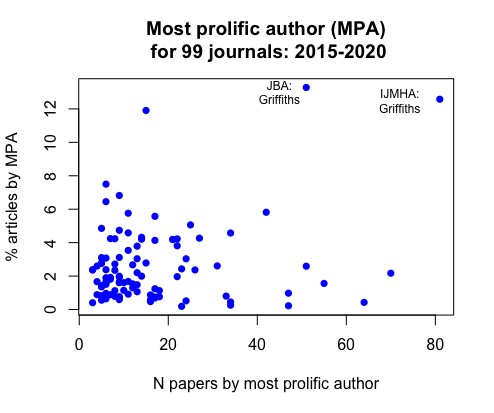
This exercise confirmed my impression that these two journals are outliers in having such a high proportion of papers contributed by one author – in this case Griffiths - as shown in Figure 3. It is noteworthy that a few journals have authors who contributed a remarkably high number of papers, but these tended to be journals with very large numbers of papers (on the right hand side of Figure 3), and so the proportion is less striking. The table corresponding to Figure 3, and the script used to generate the summary data, are available here.

Figure 3: Each point corresponds to one journal: scatterplot shows the N papers and percentage of papers contributed by the most prolific author in that journal

I then repeated this same procedure for the journals involved in bad editorial practices that I featured in earlier blogposts. As shown in Table 1, this 'percent by most prolific' score was also unusually high for those journals during the period when I identified overly brief editorial decision times, but has subsequently recovered to something more normal under new editors. (Regrettably, the publishers have taken no action on the unreviewed papers in these journals, which continue to pollute the literature in this field.)

JournalYear range N articlesMost prolific author% by prolific
Research in Developmental Disabilities2015-2019972Steenbergen B1.34

2010-20141665Sigafoos J3.78

2005-2009337Matson JL9.2

2000-2004173Matson JL8.09
Research in Autism Spectrum Disorders2015-2019448Gal E1.34

2010-2014777Matson JL10.94

2005-2009182Matson JL15.93
J Developmental and Physical Disabilities2015-2019279Bitsika V4.3

2010-2014226Matson JL10.62

2005-2009187Matson JL9.63

2000-2004126Ryan B3.17
Developmental NeuroRehabilitation2015-2019327Falkmer T3.98

2010-2014252Matson JL13.89

2005-200973Haley SM5.48


Table 1: Analysis of 'percentage by most prolific' publications in four journals with evidence of editorial bias. Those with '% most prolific' scores > 8 are shown in pink.

Could the 'percent by most prolific' score be an indicator of editorial bias? This cannot be assumed: it could be the case that Griffiths produces an enormous amount of high quality work, and chooses to place it in one of two journals that have a relevant readership. Nevertheless, this publishing profile, with one author accounting for more than 10% of the papers in two separate journals, is unusual enough to raise a red flag that the usual peer review process might have been subverted. That flag could easily be lowered if we had information on dates of submission and acceptance of papers, or, better still, open peer review.

I will be writing to Springer, the publisher of IJMHA, and AK Journals, the publisher of JBA, to recommend that they investigate the unusual publication patterns in their journals, and to ask that in future they explicitly report dates of submission and acceptance of papers, as well as the identity of the editor who was responsible for the peer review process. A move to open peer review is a much bigger step adopted by some journals that has been important in giving confidence that ethical publishing practices are followed. Such transparent practices are important not just for detecting problems, but also for ensuring that question marks do not hang unfairly over the heads of authors and editors.

**Update** 20th July 2020.
AK Journals have responded with a very prompt and detailed account of an investigation that they have conducted into the publications in their journal, which finds no evidence of any preferential treatment of papers by Prof Griffiths. See their comment below.  Note also that, contrary to my statement above, dates of receipt/decision for papers in JBA are made public: I could not find them online but they are included in the pdf version of papers published in the journal.

**Update2** 21st July 2020
Professor Griffiths has written two blogposts responding to concerns about his numerous publications in JBA and IJMHA.
In the first, he confirms that the papers in both journals were properly peer-reviewed (as AK journals have stated in their response), and in the second, he makes the case that he met criteria for authorship in all papers, citing endorsements from co-authors.   
I will post here any response I get from IJMHA.  

**Update3** 19th Sept 2020

Springer publishers confirmed in July that they would be conducting an investigation into the issues with IJMHA but subsequent queries have not provided any information other than that the investigation is continuing. 

Meanwhile, it is good to see that the data from the original paper that sparked off this blogpost have now been deposited on OSF, and a correction regarding the results of that study has now also appeared in the journal.