Yesterday, I attended a meeting at 10, Downing Street with Dominic Cummings, special advisor to Boris Johnson, for a discussion about science funding. I suspect my invitation will be regarded, in hindsight, as a mistake, and I hope some hapless civil servant does not get into trouble over it. I discovered that I was on the invitation list because of a recommendation by the eminent mathematician, Tim Gowers, who is someone who is venerated by Cummings. Tim wasn't able to attend the meeting, but apparently he is a fan of my blog, and we have bonded over a shared dislike of the evil empire of Elsevier. I had heard that Cummings liked bold, new ideas, and I thought that I might be able to contribute something, given that science funding is something I have blogged about.
The invitation came on Tuesday and, having confirmed that it was not a spoof, I spent some time reading Cummings' blog, to get a better idea of where he was coming from. The impression is that he is besotted with science, especially maths and technology, and impatient with bureaucracy. That seemed promising common ground.
The problem, though, is that as a major facilitator of Brexit in 2016, who is now persisting with the idea that Brexit must be achieved "at any cost", he is doing immense damage, because science transcends national boundaries. Don't just take my word for it: it's a message that has been stressed by the President of the Royal Society, the Government's Chief Scientific Advisor, the Chair of the Wellcome Trust, the President of the Academy of Medical Sciences, and the Director of the Crick Institute, among others.
The day before the meeting, I received an email to say that the topic of discussion would be much narrower than I had been led to believe. The other invitees were four Professors of Mathematics and the Director of the Engineering and Physical Sciences Research Council. We were sent a discussion document written by one of the professors outlining a wish list for improvements in funding for academic mathematics in the UK. I wasn't sure if I was a token woman: I suspect Cummings doesn't go in for token women and that my invite was simply because it had been assumed that someone recommended by Gowers would be a mathematician. I should add that my comments here are in a personal capacity and my views should not be taken as representing those of the University of Oxford.
The meeting started, rather as expected, with Cummings saying that we would not be talking about Brexit, because "everyone has different views about Brexit" and it would not be helpful. My suspicion was that everyone around the table other than Cummings had very similar views about Brexit, but I could see that we'd not get anywhere arguing the point. So we started off feeling rather like a patient who visits a doctor for medical advice, only to be told "I know I just cut off your leg, but let's not mention that."
The meeting proceeded in a cordial fashion, with Cummings expressing his strong desire to foster mathematics in British universities, and asking the mathematicians to come up with their "dream scenario" for dramatically enhancing the international standing of their discipline over the next few years. As one might expect, more funding for researchers at all levels, longer duration of funding, plus less bureaucracy around applying for funding were the basic themes, though Brexit-related issues did keep leaking in to the conversation – everyone was concerned about difficulties of attracting and retaining overseas talent, and about loss of international collaborations funded by the European Research Council. Cummings was clearly proud of the announcement on Thursday evening about easing of visa restrictions on overseas scientists, which has potential to go some way towards mitigating some of the problems created by Brexit. I felt, however, that he did not grasp the extent to which scientific research is an international activity, and breakthroughs depend on teams with complementary skills and perspectives, rather than the occasional "lone genius". It's not just about attracting "the very best minds from around the world" to come and work here.
Overall, I found the meeting frustrating. First, I felt that Cummings was aware that there was a conflict between his twin aims of pursuit of Brexit and promotion of science, but he seemed to think this could be fixed by increasing funding and cutting regulation. I also wonder where on earth the money is coming from. Cummings made it clear that any proposals would need Treasury approval, but he encouraged the mathematicians to be ambitious, and talked as if anything was possible. In a week when we learn the economy is shrinking for the first time in years, it's hard to believe he has found the forest of magic money trees that are needed to cover recent spending announcements, let alone additional funding for maths.
Second, given Cummings' reputation, I had expected a far more wide-ranging discussion of different funding approaches. I fully support increased funding for fundamental mathematics, and did not want to cut across that discussion, so I didn't say much. I had, however, expected a bit more evidence of creativity. In his blog, Cummings refers to the Defense Advanced Research Projects Agency (DARPA), which is widely admired as a model for how to foster innovation. DARPA was set up in 1958 with the goal of giving the US superiority in military and other technologies. It combined blue-skies and problem-oriented research, and was immensely successful, leading to the development of the internet, among other things. In his preamble, Cummings briefly mentioned DARPA as a useful model. Yet, our discussion was entirely about capacity-building within existing structures.
Third, no mention was made of problem-oriented funding. Many scientists dislike having governments control what they work on, and indeed, blue-skies research often generates quite unexpected and beneficial outcomes. But we are in a world with urgent problems that would benefit from focussed attention of an interdisciplinary, and dare I say it, international group of talented scientists. In the past, it has taken world wars to force scientists to band together to find solutions to immediate threats. The rapid changes in the Arctic suggest that the climate emergency should be treated just like a war - a challenge to be tackled without delay. We should be deploying scientists, including mathematicians, to explore every avenue to mitigating the effects of global heating – physical and social – right now. Although there is interesting research on solar geoengineering going on at Harvard, it is clear that, under the Trump administration, we aren't going to see serious investment from the USA in tackling global heating. And, in any case, a global problem as complex as climate needs a multi-pronged solution. The economist Marianna Mazzucato understands this: her proposals for mission-oriented research take a different approach to the conventional funding agencies we have in the UK. Yet when I asked whether climate research was a priority in his planning, Cummings replied "it's not up to me". He said that there were lots of people pushing for more funding for research on "climate change or whatever", but he gave the impression that it was not something he would give priority to, and he did not display a sense of urgency. That's surprising in someone who is scientifically literate and has a child.
In sum, it's great that we have a special advisor who is committed to science. I'm very happy to see mathematics as a priority funding area. But I fear Dominic Cummings overestimates the extent to which he can mitigate the negative consequences of Brexit, and it is particularly unfortunate that his priorities do not include the climate emergency that is unfolding.
Showing posts with label funding. Show all posts
Showing posts with label funding. Show all posts
Saturday, 10 August 2019


Saturday, 20 July 2019
A call for funders to ban institutions that use grant capture targets
I caused unease on Twitter this week when I criticised a piece in the Times Higher Education on 'How to win a research grant'. As I explained in a series of tweets, I have no objection to experienced grant-holders sharing their pearls of wisdom with other academics: indeed, I've given my own tips in the past. My objection was to the sentiment behind the lede beneath the headline: "Even in disciplines in which research is inherently inexpensive, ‘grant
capture’ is increasingly being adopted as a metric to judge academics
and universities. But with success rates typically little better than
one in five, rejection is the fate of most applications." I made the observation that it might have been better if the Times Higher had noted that grant capture is a stupid way to evaluate academics.
Science is in trouble when the getting of grant funding is seen as an end in itself rather than a means to the end of doing good research, with researchers rewarded in proportion to how much money they bring in. I've rehearsed the arguments for this view more than once on my blog (see, e.g. here); many of these points were anticipated by Raphael Gillett in 1991, long before 'grant capture' became widespread as an explicit management tool. Although my view is shared by some other senior figures (see, e.g., this piece by John Ioannidis), it is seldom voiced. When I suggested that the best approach to seeking funding was to wait until you had a great idea that you were itching to implement, the patience of my followers snapped. It was clear that to many people working in academia, this view is seen as naive and unrealistic. Quite simply, it's a case of get funded or get fired. When I started out, use of funding success may have been used informally to rate academics, but now it is often explicit, sometimes to the point whereby expected grant income targets are specified.
Encouraging more and more grant submissions is toxic, both for researchers and for science, but everyone feels trapped. So how could we escape from this fix?
I think the solution has to be down to funders. They should be motivated to tackle the problem for several reasons.
My suggestion is that major funders such as Research England, Wellcome Trust and Cancer Research UK could at a stroke improve research culture in the UK by implementing a rule whereby any institution that used grant capture as a criterion for hiring, firing or promotion would be ineligible to host grants.
Reference
Gillett, R. (1991). Pitfalls in assessing research performance by grant income. Scientometrics, 22(2), 253-263.
Science is in trouble when the getting of grant funding is seen as an end in itself rather than a means to the end of doing good research, with researchers rewarded in proportion to how much money they bring in. I've rehearsed the arguments for this view more than once on my blog (see, e.g. here); many of these points were anticipated by Raphael Gillett in 1991, long before 'grant capture' became widespread as an explicit management tool. Although my view is shared by some other senior figures (see, e.g., this piece by John Ioannidis), it is seldom voiced. When I suggested that the best approach to seeking funding was to wait until you had a great idea that you were itching to implement, the patience of my followers snapped. It was clear that to many people working in academia, this view is seen as naive and unrealistic. Quite simply, it's a case of get funded or get fired. When I started out, use of funding success may have been used informally to rate academics, but now it is often explicit, sometimes to the point whereby expected grant income targets are specified.
Encouraging more and more grant submissions is toxic, both for researchers and for science, but everyone feels trapped. So how could we escape from this fix?
I think the solution has to be down to funders. They should be motivated to tackle the problem for several reasons.
- First, they are inundated with far more proposals than they can fund - to the extent that many of them use methods of "demand management" to stem the tide.
- Second, if people are pressurised into coming up with research projects in order to become or remain employed, this is not likely to lead to particularly good research. We might expect quality of proposals to improve if people are encouraged to take time to develop and hone a great idea.
- Third, although peer review of grants is generally thought to be the best among various unsatisfactory options for selecting grants, it is known to have poor reliability, and there is an element of lottery as to who gets funded. There's a real risk that, with grant capture being used as a metric, many researchers are being lost from the system because they were unlucky rather than untalented.
- Fourth, if people are evaluated in terms of the amount of funding they acquire, they will be motivated to make their proposals as expensive as possible: this cannot be in the interests of the funders.
My suggestion is that major funders such as Research England, Wellcome Trust and Cancer Research UK could at a stroke improve research culture in the UK by implementing a rule whereby any institution that used grant capture as a criterion for hiring, firing or promotion would be ineligible to host grants.
Reference
Gillett, R. (1991). Pitfalls in assessing research performance by grant income. Scientometrics, 22(2), 253-263.
Wednesday, 24 October 2018
Has the Society for Neuroscience lost its way?
The tl;dr version: The Society for Neuroscience (SfN) makes humongous amounts of money from its journal and meetings, but spends very little on helping its members, while treating overseas researchers with indifference bordering on disdain.
I first became concerned about the Society for Neuroscience back in 2010 when I submitted a paper to the Journal of Neuroscience. The instructions to authors explained that there was a submission fee (at the time about $50). Although I 'd never come across such a practice before, I reckoned it was not a large sum, and so went ahead. The Instructions for Authors explained that there was a veto on citation of unpublished work. I wanted to cite a paper of mine that had been ‘accepted in principle’ but needed minor changes, and I explained this in my cover letter. Nevertheless, the paper was desk-rejected because of this violation. A week later, after the other paper was accepted, I updated the manuscript and resubmitted it, but was told that I had to pay another submission fee. I got pretty grumbly at this point, but given that we'd spent a lot of time formatting the paper for J Neuroscience, I continued with the process. We had an awful editor (the Automaton described here), but excellent reviewers, and the paper was ultimately accepted.
But then we were confronted with the publication fee and charges for using colour figures. These were substantial – I can’t remember the details but it was so much that it turned out cheaper for all the authors to join the SfN, which made us eligible for reduced rates on publication fees. So for one year I became a member of the society.
The journal’s current policy on fees can be found here. Basically, the submission fee is now $140, but this is waived if first and last authors are SfN members (at cost of $200 per annum for full members, going down to $150 for postdocs and $70 for postgrads). The publication fee is $1,260 (for members) and $1,890 for non-members, with an extra $2,965 if you want the paper to be made open access.
There are some reductions for those working in resource-restricted countries, but the sums involved are still high enough to act as a deterrent. I used Web of Science to look at country of origin for Journal of Neuroscience papers since 2014, and there’s no sign that those from resource-restricted countries are taking advantage of the magnanimous offer to reduce publication fees by up to 50%.
The justification given for these fees is that ‘The submission fee covers a portion of the costs associated with peer review’, with the implication that the society is subsidising the other portion of the costs. Yet, when we look at their financial statements (download pdf here), they tell a rather different story. As we can see in the table on p 4, in 2017 the expenses associated with scientific publications came to $4.84 million, whereas the income from this source was $7.09 million.
But maybe the society uses journal income to subsidise other activities that benefit its nearly 36,000 members? That’s a common model in societies I’m involved in. But, no, the same financial report shows that the cost of the annual SfN meeting in 2017 was $9.5 million, but the income was $14.8 million. If we add in other sources of income, such as membership dues, we can start to understand how it is that the net assets of the society increased from $46.6 million in 2016 to $58.7 million in 2017.
This year, SfN has had a new challenge, which is that significant numbers of scientists are being denied visas to attend the annual meeting, as described in this piece by the Canadian Association for Neuroscience. This has led to calls for the annual meeting to be held outside the US in future years. The SfN President has denounced the visa restrictions as a thoroughly bad thing. However, it seems that SfN has not been sympathetic to would-be attendees who joined the society in order to attend the meeting, only to find that they would not be able to do so. I was first alerted to this on Twitter by this tweet:

This attracted a fair bit of adverse publicity for SfN, and just over a week later Chris heard back from the Executive Director of SfN who had explained that whereas they could refund registration fees for those who could not attend, they were not willing refund on membership fees. No doubt for an organisation that is sitting on long-term investments of $71.2 million (see table below), the $70 membership fee for a student is chicken feed. But I suspect it doesn’t feel like that to the student, who has probably also incurred costs for submitting an unsuccessful visa application.
There appears to be a mismatch between the lofty ideals described in SfN's mission statement and their behaviour. They seem to have lost their way: instead of being an organisation that exists to promote neuroscience and help their members, the members are rather regarded as nothing but a source of income, which is then stashed away in investments. It’s interesting to see that under Desired Outcomes, the Financial Reserve Strategy section of the mission statement has: ‘Strive to achieve end of year financial results that generate net revenues between $500,000 and $1 million in annual net operating surplus.’ That is reasonable and prudent for a large organisation with employees and property. But SfN is not achieving that goal: they are making considerably more money than their own mission statement recommends.
That money could be put to good use. In particular, given SfN’s stated claim of wanting to support neuroscience globally, they could offer grants for scientists in resource-poor countries to buy equipment, pay for research assistants or attend meetings. Quite small sums could be transformational in such a context. As far as I can see, SfN currently offers a few awards, but some of these are paid for by external donations, and, in relation to their huge reserves, the sums are paltry. My impression is that other, much smaller, societies do far more with limited funds than SfN does with its bloated income.
Maybe I’m missing something. I’m no longer a member of SfN, so it’s hard to judge. Are there SfN members out there who think the society does a good job for its membership?
I first became concerned about the Society for Neuroscience back in 2010 when I submitted a paper to the Journal of Neuroscience. The instructions to authors explained that there was a submission fee (at the time about $50). Although I 'd never come across such a practice before, I reckoned it was not a large sum, and so went ahead. The Instructions for Authors explained that there was a veto on citation of unpublished work. I wanted to cite a paper of mine that had been ‘accepted in principle’ but needed minor changes, and I explained this in my cover letter. Nevertheless, the paper was desk-rejected because of this violation. A week later, after the other paper was accepted, I updated the manuscript and resubmitted it, but was told that I had to pay another submission fee. I got pretty grumbly at this point, but given that we'd spent a lot of time formatting the paper for J Neuroscience, I continued with the process. We had an awful editor (the Automaton described here), but excellent reviewers, and the paper was ultimately accepted.
But then we were confronted with the publication fee and charges for using colour figures. These were substantial – I can’t remember the details but it was so much that it turned out cheaper for all the authors to join the SfN, which made us eligible for reduced rates on publication fees. So for one year I became a member of the society.
The journal’s current policy on fees can be found here. Basically, the submission fee is now $140, but this is waived if first and last authors are SfN members (at cost of $200 per annum for full members, going down to $150 for postdocs and $70 for postgrads). The publication fee is $1,260 (for members) and $1,890 for non-members, with an extra $2,965 if you want the paper to be made open access.
There are some reductions for those working in resource-restricted countries, but the sums involved are still high enough to act as a deterrent. I used Web of Science to look at country of origin for Journal of Neuroscience papers since 2014, and there’s no sign that those from resource-restricted countries are taking advantage of the magnanimous offer to reduce publication fees by up to 50%.
 | |
| Countries of origin from papers in Journal of Neuroscience (2014-2018) |
But maybe the society uses journal income to subsidise other activities that benefit its nearly 36,000 members? That’s a common model in societies I’m involved in. But, no, the same financial report shows that the cost of the annual SfN meeting in 2017 was $9.5 million, but the income was $14.8 million. If we add in other sources of income, such as membership dues, we can start to understand how it is that the net assets of the society increased from $46.6 million in 2016 to $58.7 million in 2017.
This year, SfN has had a new challenge, which is that significant numbers of scientists are being denied visas to attend the annual meeting, as described in this piece by the Canadian Association for Neuroscience. This has led to calls for the annual meeting to be held outside the US in future years. The SfN President has denounced the visa restrictions as a thoroughly bad thing. However, it seems that SfN has not been sympathetic to would-be attendees who joined the society in order to attend the meeting, only to find that they would not be able to do so. I was first alerted to this on Twitter by this tweet:

This attracted a fair bit of adverse publicity for SfN, and just over a week later Chris heard back from the Executive Director of SfN who had explained that whereas they could refund registration fees for those who could not attend, they were not willing refund on membership fees. No doubt for an organisation that is sitting on long-term investments of $71.2 million (see table below), the $70 membership fee for a student is chicken feed. But I suspect it doesn’t feel like that to the student, who has probably also incurred costs for submitting an unsuccessful visa application.
 |
| Table from p 8 of SfN Annual Financial Report for 2017; The 'alternative investments' are mostly offshore funds in the Cayman Islands and elsewhere |
That money could be put to good use. In particular, given SfN’s stated claim of wanting to support neuroscience globally, they could offer grants for scientists in resource-poor countries to buy equipment, pay for research assistants or attend meetings. Quite small sums could be transformational in such a context. As far as I can see, SfN currently offers a few awards, but some of these are paid for by external donations, and, in relation to their huge reserves, the sums are paltry. My impression is that other, much smaller, societies do far more with limited funds than SfN does with its bloated income.
Maybe I’m missing something. I’m no longer a member of SfN, so it’s hard to judge. Are there SfN members out there who think the society does a good job for its membership?
Sunday, 12 January 2014
Why does so much research go unpublished?

In order to tackle this problem, we need to understand the underlying causes. Sometimes, as Robert Burns noted, the best-laid schemes go wrong. Until you've tried to run a few research projects, it's hard to imagine the myriad different ways in which life can conspire to mess up your plans. The eight laws of psychological research formulated by Hodgson and Rollnick are as true today as they were 25 years ago.
But much research remains unpublished despite being completed. Reasons are multiple, and the strategies needed to overcome them are varied, but here is my list of the top three problems and potential solutions.
Inconclusive results
Probably the commonest reason for inconclusive results is lack of statistical power. A study is undertaken in the fond hope that a difference will be found between condition X and condition Y, and if the difference is found, there is great rejoicing and a rush to publish. A negative result should also be of interest, provided the study was well-designed and adequately motivated. But if the sample is small, then we can't be sure whether our failure to observe the effect is because it is absent: a real but small effect could be swamped by noise.
I think the solution to this problem lies in the hands of funding panels and researchers: quite simply, they need to take statistical power very seriously indeed and to consider carefully whether anything will be learned from a study if the anticipated effects are not obtained. If not, then the research needs to be rethought. In the fields of genetics and clinical trials, it is now recognised that multicentre collaborations are the way forward to ensure that studies are conducted with sufficient power to obtain a conclusive result.
Rejection of completed work by journals
Even well-conducted and adequately powered studies may be rejected by journals if the results are not deemed to be exciting. To solve this problem, we must look to journals. We need recognition that - provided a study is methodologically strong and well-motivated - negative results can be as informative as positive ones. Otherwise we are doomed to waste time and money pursuing false leads. As Paul Glasziou has emphasised, failure is part of the research process. It is important to tell people about what doesn't work if we are not to repeat our mistakes.
We do now have some journals that will publish negative results, and there is a growing move toward pre-registration of studies, with guaranteed publication if the methods meet quality criteria. But there is still a lot to be done, and we need a radical change of mindset about what kinds of research results are valuable.
Lack of time
Here, I lay the blame squarely on the incentive structures that operate in universities. To get a job, or to get promoted, you need to demonstrate that you can pull in research income. In many UK institutions this is quite explicit, and promotions criteria may give a specific figure to aim for of X thousand pounds research income per annum. There are few UK universities whose strategic plan does not include a statement about increasing research funding. This has changed the culture dramatically; as Fergus Millar put it: "in the modern British university, it is not that funding is sought in order to carry out research, but that research projects are formulated in order to get funding".
Of course, for research to thrive, our Universities need people who can compete for funding to support their work. But the acquisition of funding has become an end in itself, rather than a means to an end. This has the pernicious effect of driving people to apply for grant after grant, without adequately budgeting for the time it takes to analyse and write up research, or indeed to carefully think about what they are doing. As I argued previously, even junior researchers these days have an 'academic backlog' of unwritten papers.
At the Lancet meeting there were some useful suggestions for how we might change incentive structures to avoid such waste. Malcolm MacLeod argued researchers should be evaluated not by research income and high-impact publications, but by the quality of their methods, the extent to which their research was fully reported, and the reproducibility of findings. An-Wen Chan echoed this, arguing for performance metrics that recognise full dissemination of research and use of research datasets by other groups. However, we may ask whether such proposals have any chance of being adopted when University funding is directly linked to grant income, and Universities increasingly view themselves as businesses.
I suspect we would need revised incentives to be reflected at the level of those allocating central funding before vice-chancellors took them seriously. It would, however, be feasible for behaviour to be shaped at the supply end, if funders adopted new guidelines. For a start, they could look more carefully at the time commitments of those to whom grants are given: in my experience this is never taken into consideration, and one can see successful 'fat cats' accumulating grant after grant, as success builds on success. Funders could also monitor more closely the outcomes of grants: Chan noted that NIHR withholds 10% of research funds until a paper based on the research has been submitted for publication. Moves like this could help us change the climate so that an award of a grant would confer responsibility on the recipient to carry through the work to completion, rather than acting solely to embellish the researcher's curriculum vitae.
References
Chan, A., Song, F., Vickers, A., Jefferson, T., Dickersin, K., Gotzsche, P., Krumholz, H. M., Ghersi, D., & van der Worp, H. B. (2014). Increasing value and reducing waste: addressing inaccessible research Lancet (8 Jan ) : 10.1016/S0140-6736(13)62296-5Macleod, M. R., Michie, S., Roberts, I., Dirnagl, U., Chalmers, I., Ioannidis, J. P. A., . . . Glasziou, P. (2014). Biomedical research: increasing value, reducing waste. Lancet, 383(9912), 101-104.
Thursday, 9 January 2014
Off with the old and on with the new: the pressures against cumulative research

I was excited by the symposium because, although the focus was on medicine, it raised a number of issues that have much broader relevance for science, including several that I have raised on this blog, including pre-registration of research, criteria used by high-impact journals, ethics regulation, academic backlogs, and incentives for researchers. It was impressive to see that major players in the field of medicine are now recognizing that there is a massive problem of waste in research. Better still, they are taking seriously the need to devise ways in which this could be fixed.
I hope to blog about more of the issues that came up in the meeting, but for today I'll confine myself to one topic that I hadn't really thought about much before, but which I see as important, namely the importance of doing research that builds on previous research, and the current pressures against this.
Iain Chalmers presented one of the most disturbing slides of the day, a forest plot of effect sizes found in medical trials for a treatment to prevent bleeding during surgery.
 |
| Based on Figure 3 of Chalmers et al, 2014 |
Outside medicine, I'm not sure this is so much of an issue. In fact, as I've argued elsewhere, in psychology and neuroscience I think there's more of a problem with lack of replication. But there definitely is much neglect of prior research. I lose count of the number of papers I review where the introduction presents a biased view of the literature that supports the authors' conclusions. For instance, if you are interested in the relation between auditory deficit and children's language disorders, it is possible to write an introduction presenting this association as an established fact, or to write one arguing that it has been comprehensively debunked. I have seen both.
Is this just lazy, biased or ignorant authors? In part, I suspect it is. But I think there is a deeper problem which has to do with the insatiable demand for novelty shown by many journals, especially the high-impact ones. These journals typically have a lot of pressure on page space and often allow only 500 words or less for an introduction. Unless authors can refer to a systematic review of the topic they are working on, they are obliged to give the briefest account of prior literature. It seems we no longer value the idea that research should build on what has gone before: rather, everyone wants studies that are so exciting that they stand alone. Indeed, if a study is described as 'incremental' research, that is typically the death knell in a funding committee.
We need good syntheses of past research, yet these are not valued because they are not deemed novel. One point made by Iain Chalmers was that funders have in the past been reluctant to give grants for systematic reviews. Reviews also aren't rated highly in academia: for instance, I'm proud of a review on mismatch negativity that I published in Psychological Bulletin in 2007. It not only condensed and critiqued existing research, but also discovered patterns in data that had not previously been noted. However, for the REF, and for my publications list on a grant renewal, reviews don't count.
We need a rethink of our attitude to reviews. Medicine has led the way and specified rigorous criteria for systematic reviews, so that authors can't just cherrypick specific studies of interest. But it has also shown us that such reviews are an invaluable part of the research process. They help ensure that we do not waste resources by addressing questions that have already been answered, and they encourage us to think of research as a cumulative, developing process, rather than a series of disconnected, dramatic events.
Reference
Chalmers, Iain, Bracken, Michael B., Djulbegovic, Ben, Garattini, Silvio, Grant, Jonathan, Gülmezoglu, A. Metin, Howells, David W., Ioannidis, John P. A., & Oliver, Sandy (2014). How to increase value and reduce waste when research priorities are set Lancet : 10.1016/S0140-6736(13)62229-1
Tuesday, 15 October 2013
The Matthew effect and REF2014

For unto every one that hath shall be given, and he shall have abundance: but from him that hath not shall be taken away even that which he hath. Matthew 25:29
So you’ve slaved over your departmental submission for REF2014, and shortly will be handing it in. A nervous few months await before the results are announced. You’ve sweated blood over deciding whether staff publications or impact statements will be graded as 1*, 2*, 3* or 4*, but it’s not possible to predict how the committee will judge them, nor, more importantly, how these ratings will translate into funding. In the last round of evaluation, in 2008, a weighted formula was used, such that a submission earned 1 point for every 2* output, 3 points for every 3* output, and 7 points for every 4* output. Rumour has it that this year there may be no money for 2* outputs and even more for 4*. It will be more complicated than this, because funding allocations will also take into account ratings of ‘impact statements’, and the ‘environment’.
I’ve blogged previously about concerns I have with the inefficiency of the REF2014 as a method for allocating funds. Today I want to look at a different issue: the extent to which the REF increases disparities between universities over time. To examine this, I created a simulation which made a few simple assumptions. We start with a sample of 100 universities, each of which is submitting 50 staff in a Unit of Assessment. At the outset, we start with all universities equal in terms of the research quality of their staff: they are selected at random from a pool of possible staff whose research quality is normally distributed. Funding is then allocated according to the formula used in RAE2008. The key feature of the simulation is that over every assessment period there is turnover of staff (estimated at 10% in simulation shown here), and universities with higher funding levels are able to recruit replacement staff with higher scores on the research quality scale. These new staff are then the basis for computing funding allocations in the next cycle – and so on, through as many cycles as one wishes. This simulation shows that funding starts out fairly normally distributed, but as we progress through each cycle, it becomes increasingly skewed, with the top-performers moving steadily away from the rest (Figure A). In the graphs, funding is shown over time for universities grouped in deciles, i.e., bands of 10 universities after ranking by funding level.
 |
| Simulation: Mean income for universities in each of 10 deciles over 6 funding cycles |
We could do things differently. Figure B shows how tweaking the funding model could avoid opening up such a wide gulf between the richest and poorest, and retain a solid core of middle-ranking universities.
 |
| Simulation using linear weighting of * levels. Each line is average for institutions in a given decile |
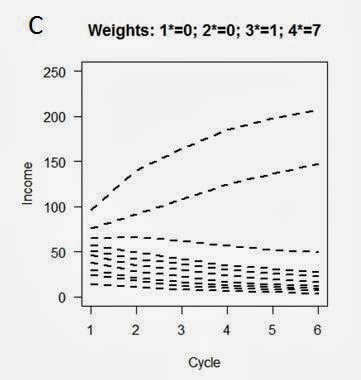 |
| Simulation where 4* outputs get favoured. Each line is average for institutions in a given decile |
However, given that finances are always limited, there will be a cost to the focus on an elite; the middle-ranking universities will get less funding, and be correspondingly less able to attract high-calibre researchers. And it could be argued that we don’t just need an elite: we need a reasonable number of institutions in which there is a strong research environment, where more senior researchers feel valued and their graduate students and postdocs are encouraged to aim high. Our best strategy for retaining international competitiveness might be by fostering those who are doing well but have potential to do even better. In any case, much research funding is awarded through competition for grants, and most of this goes to people in elite institutions, so these places will not be starved of income if we were to adopt a more balanced system of awarding central funds.
What worries me most is that I haven’t been able to find any discussion of this issue – namely, whether the goal of a funding formula should be to focus on elite institutions or distribute funds more widely. The nearest thing I’ve found so far is a paper analysing a parallel issue in grant awards (Fortin & Curry, 2013) – which comes to the conclusion that broader distribution of smaller grants is more effective than narrowly distributed large grants. Very soon, somebody somewhere is going to decide on the funding formula, and if rumours are to be believed, it will widen the gap between the haves and have-nots even further. I'm concerned that if we continue to concentrate funding only in those institutions with a high proportion of research superstars, we may be creating an imbalance in our system of funding that will be bad for UK research in the long run.
Reference
Fortin JM, & Currie DJ (2013). Big Science vs. Little Science: How Scientific Impact Scales with Funding. PloS one, 8 (6) PMID: 23840323
Saturday, 26 January 2013
An alternative to REF2014?

Consider the current criteria for rating research outputs, designed by someone with a true flair for ambiguity:
| Rating | Definition |
|---|---|
| 4* | Quality that is world-leading in terms of originality, significance and rigour |
| 3* | Quality that is internationally excellent in terms of originality, significance and rigour but which falls short of the highest standards of excellence |
| 2* | Quality that is recognised internationally in terms of originality, significance and rigour |
| 1* | Quality that is recognised nationally in terms of originality, significance and rigour |
Since only 4* and 3* outputs will feature in the funding formula, then a great deal hinges on whether research is deemed “world-leading”, “internationally excellent” or “internationally recognised”. This is hardly transparent or objective. That’s one reason why many institutions want to translate these star ratings into journal impact factors. But substituting a discredited, objective criterion for a subjective criterion is not a solution.
The use of bibliometrics was considered but rejected in the past. My suggestion is that we should reconsider this idea, but in a new version. A few months ago, I blogged about how university rankings in the previous assessment exercise (RAE) related to grant income and citation rates for outputs. Instead of looking at citations for individual researchers, I used Web of Science to compute an H-index for the period 2000-2007 for each department, by using the ‘address’ field to search. As noted in my original post, I did this fairly hastily and the method can get problematic in cases where a Unit of Assessment does not correspond neatly to a single department. The H-index reflected all research outputs of everyone at that address – regardless of whether they were still at the institution or entered for the RAE. Despite these limitations, the resulting H-index predicted the RAE results remarkably well, as seen in the scatterplot below, which shows H-index in relation to the funding level following from RAE. This is computed by number of full-time staff equivalents multiplied by the formula:
.1 x 2* + .3 x 3* + .7 x 4*
(N.B. I ignored subject weighting, so units are arbitrary).
 |
| Psychology (Unit of Assessment 44), RAE2008 outcome by H-index |
So overall, my conclusion is that we might be better off using a bibliometric measure such as a departmental H-index to rank departments. It is crude and imperfect, and I suspect it would not work for all disciplines – especially those in the humanities. It relies solely on citations, and it's debatable whether that is desirable. But for sciences, it seems to be pretty much measuring whatever the RAE was measuring, and it would seem to be the lesser of various possible evils, with a number of advantages compared to the current system. It is transparent and objective, it would not require departments to decide who they do and don’t enter for the assessment, and most importantly, it wins hands down on cost-effectiveness. If we'd used this method instead of the RAE, a small team of analysts armed with Web of Science should be able to derive the necessary data in a couple of weeks to give outcomes that are virtually identical to those of the RAE. The money saved both by HEFCE and individual universities could be ploughed back into research. Of course, people will attempt to manipulate whatever criterion is adopted, but this one might be less easily gamed than some others, especially if self-citations from the same institution are excluded.
It will be interesting to see how well this method predicts RAE outcomes in other subjects, and whether it can also predict results from the REF2014, where the newly-introduced “impact statement” is intended to incorporate a new dimension into assessment.
Sunday, 15 July 2012
The devaluation of low-cost psychological research

In academic research, money follows money. This is quite
explicit in funding systems that reward an institution in proportion to their
research income. This makes sense: an institution that is doing costly research
needs funding to support the infrastructure for that research. The problem is
that the money, rather than the research, can become the indicator of success. Hiring
committees will scrutinise CVs for evidence of ability to bring in large
grants. My guess is that, if choosing between one candidate with strong
publications and modest grant income vs. another with less influential
publications and large grant income, many would favour the latter.
Universities, after all, have to survive in a tough financial climate, and so
we are all exhorted to go after large grants to help shore up our institution's
income. Some Universities have even taken to firing people who don't bring in
the expected income. This means that cheap cost-effective research in
traditional psychological areas will be devalued relative to more expensive
neuroimaging.
I have no quarrel, in principle, with psychologists doing
neuroimaging studies - some of my best friends are neuroimagers - and it is important that if good science is to be done in
this area that it should be properly funded. I am uneasy, though, about an
unintended consequence of the enthusiasm for neuroimaging, which is that it has
led to a devaluation of the other kinds of psychological research. I've been
reading Thinking Fast and Slow,
by Daniel Kahneman, a psychologist who has the rare distinction of
being a Nobel Laureate. This is just one example of a psychologist who has made major advances without using brain scanners. I couldn't help thinking that Kahneman would not fare
well in the current academic climate, because his experiments were simple,
elegant ... and inexpensive.
I've suggested previously that systems of academic rewards
need to be rejigged to take into account not just research income and
publication outputs, but the relationship between the two. Of course, some
kinds of research require big bucks, but large-scale grants are not always
cost-effective. And on the other side of the coin, there are people who do
excellent, influential work on a small budget.
I thought I'd see if it might be possible to get some hard
data on how this works in practice. I used data for Psychology Departments from
the last Research Assessment Exercise (RAE), from this website, and matched
this up against citation counts for publications that came out in the same time
period (2000-2007) from Web of Knowledge. The latter is a bit tricky, and I'm
aware that figures may contain inaccuracies, as I had to search by address,
using the name of the institution coupled with the words Psychology and UK. This will miss articles that don't have these words in the address. Also when double-checking the numbers, I found that for a search by address, results can fluctuate from one occasion to the next. For these reasons, I'd urge readers to treat the results with caution, and
I won't refer to institutions by name. Note too that though I restrict consideration to articles between 2000-2007, the citations extend
beyond the period when the RAE was completed. Web of Knowledge helpfully gives
you an H-index for the institution if you ask for a citation report, and this
is what I report here, as it is more stable across repeated searches than the citation count. Figure 1 shows how research income for a department
relates to its H-index, just for those institutions deemed research active,
which I defined as having a research income of at least £500K over the reporting
period. The overall RAE rating is colour-coded into bandings, and the symbol denotes
whether or not the departmental submission mentions neuroimaging as an
important part of its work.
 |
| Data from RAE and Web of Knowledge: treat with caution! |
Several features are seen in these data, and most are
unsurprising:
- Research income and H-index are positively correlated, r = .74 (95%CI .59-.84) as we would expect. Both variables are correlated with the number of staff entered in the RAE, but the correlation between them remains healthy when this factor is partialled out, r = .61 (95%CI .40-.76).
- Institutions coded as doing neuroimaging have bigger grants: after taking into account differences in number of staff, the mean income for departments with neuroimaging was £7,428K and for those without it was £3,889K (difference significant at p = .01).
- Both research income and H-index are predictive of RAE rankings: the correlations are .68 (95% CI .50-.80) for research income and .79 (95% CI .66-.87) for H-index, and together they account for 80% of the variance in rankings. We would not expect perfect prediction, given that the RAE committee went beyond metrics to assess aspects of research quality not reflected in citations or income. And in addition, it must be noted that the citations counted here are for all researchers at a departmental address, not just those entered in the RAE.
A point of concern to me in these data, though, is the wide
spread in H-index seen for those institutions with the highest levels of grant
income. If these numbers are accurate, some departments are using their
substantial income to do influential work, while others seem to achieve no more
than other departments with much less funding. There may be reasonable
explanations for this - for instance, a large tranche of funding may have been
awarded in the RAE period but not had time to percolate through to
publications. But nevertheless, it adds to my concern that we may
be rewarding those who chase big grants without paying sufficient attention to
what they do with the funding when they get it.
What, if anything, should we do about this? I've toyed in
the past with the idea of a cost-efficiency metric (e.g. citations divided by
grant income), but this would not work as a basis for allocating funds, because
some types of research are intrinsically more expensive than others. In
addition, it is difficult to get research funding, and success in this arena is
in itself an indicator that the researchers have impressed a tough committee of
their peers. So, yes, it makes sense to treat level of research funding as one indicator
of an institution's research excellence when rating departments to determine
who gets funding. My argument is simply that we should be aware of the
unintended consequences if we rely too heavily on this metric. It would be nice
to see some kind of indicator of cost-effectiveness included in ratings of
departments alongside the more traditional metrics. In times of financial
stringency, it is particularly short-sighted to discount the contribution of
researchers who are able to do influential work with relatively scant
resources.
Subscribe to:
Posts (Atom)

 Posts
Posts


