Guest post by Huanzi Zhang*
 |
| Screenshot from
https://www.wiley.com/en-us/network/publishing/research-publishing/open-access/wiley-acquires-hindawi-qa-with-liz-ferguson |
Over the past year, special issues of dozens of Hindawi journals have been exposed as being systematically manipulated, resulting in the delisting of more than 20 Hindawi journals from major journal databases, as well as the retraction of more than 2,700 papers by the publisher. This "unexpected event" at Hindawi also led to a slump in profits for the parent company, John Wiley & Sons. However, in a recent statement, the president, CEO & director of Wiley, Brian Napack, stated that Hindawi was now ready for revitalization and reinstatement of the special issue program. In my opinion, Wiley has not dealt adequately with the integrity issues that led to the problem, but appears focused on growth through the medium of special issues. This raises questions as to whether Hindawi’s operation is sustainable in the long term.
Napack’s statement can be read here. He stated:
“Fiscal '24 (starts on May 1, 2023) will be a year of revitalization for Hindawi with positive signs already emerging. We've now named a new leader of Hindawi, a talented Wiley veteran with deep expertise in the area. We've restarted the special issues program and we will be ramping it up throughout the year. We're working through the large article backlog, and we are executing our journal growth plans.”
One might, however, be forgiven for being a bit sceptical about this upbeat message, since just a year before, Napack said:
“Hindawi performed at a very high level this year, delivering strong double-digit organic revenue growth and 36% article output growth on a pro forma basis, and has achieved this with exceptional margins. We have now completed the integration and we are benefiting significantly from Hindawi's industry leading open publishing practices and its highly efficient systems.”
So what is the problem with Hindawi journals that suddenly got Wiley into trouble? Is Hindawi really well-positioned for revitalization?
Wiley’s acquisition of Hindawi
Wiley announced the acquisition of Hindawi on January 5, 2021.
The person who pushed Wiley to buy Hindawi was Judy Verses, Wiley's Executive Vice President, who left Wiley to join Elsevier a few months after the acquisition was completed. On January 11, 2021, in an interview with Verses and Wiley's Senior Vice President Liz Ferguson, we learned that Wiley expected that Hindawi journals would publish many articles by Chinese authors, expanding their market in China:
“It has surpassed the US in recent years, and in an increasing number of disciplines is undoubtedly the global leader. Hindawi had the foresight to launch and develop journals that reflect strengths in the China research space. Similar to Wiley, Hindawi identified early on how important it was to serve the needs of China-based researchers. Bringing together our two teams now means we have an even stronger position to be able to work to the needs of those researchers.”
The Publishing Perspective's interview with Jay Flynn, Senior Vice President and Chief Product Offer of Wiley Research, published on January 5, 2021, and Wiley's internal interview with Ferguson, published on February 23, 2021, mentioned the importance of China.
The new niche market for Hindawi journals seemed to respond soundly to this appointment, and the number of submissions began to increase significantly (Figure 1), while no such increase had been seen in the preceding months. In September 2021, Jay Flynn was promoted to Executive Vice President of Wiley Research to replace Judy Verses.
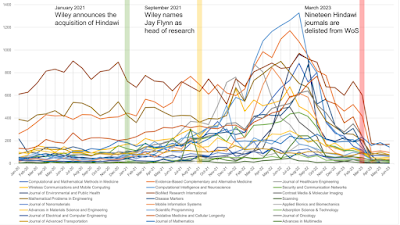 |
Figure 1. Number of submissions received per month for 24 journals that
subsequently had papers retracted by Hindawi. Data from Hindawi Journal
Report.
|
The papermill problem
The first concerns were raised by research integrity communities and individuals, who since 2021 posted thousands of comments on the PubPeer journal club relating to papers published in hundreds of special issues of Hindawi journals. Many comments were made by anonymous sleuths Rhipidura albiventris, Hoya camphorifolia and Parashorea tomentella, whose contributions sometimes exceeded 100 per day.
Problems were not limited to individual special issues or even individual journals. There appeared to be systematic manipulation of the publishing process, especially affecting special issues, indicating activities of so-called “paper mills” – fraudulent organisations that will sell authorship and/or citations of papers, often faked, for a fee. Leonid Schneider, who runs the blog For Better Science, assisted David Bimler and others in posting their findings from Hindawi journals. Nick Wise discussed “What is going on in Hindawi special issues?” on October 12, 2022. These sleuths noted that many supposedly ‘peer-reviewed’ manuscripts had incoherent or unintelligible content, and corresponding authors used email addresses from other institutions; furthermore, a large number of papers cited irrelevant references, presumably to boost citation counts; some paper mills used the article processing charge (APC) waiver policy of Hindawi to make more profit. The pattern of abnormal citations confirmed that the fraud was not bounded by journals, and so publication-based investigations made it difficult to expose specific paper mills.
It soon became clear that the special issues that were such a lucrative source of income for Hindawi were wide open to corrupt "guest editors" who, once appointed, could use fake peer review and flood the journal with fraudulent papers and irrelevant citations.
In the gold open access model, Wiley earns APCs for every article published in Hindawi journals, whether in a special issue or not, so their incentive to exert quality control is compromised. Some examples are so extreme that nobody could take them seriously, such as an article on the ideological and political education of the Chinese Communist Party in a special issue "Exploration of Human Cognition using Artificial Intelligence in Healthcare", which was submitted, peer-reviewed and received on the same day. There are thousands of other papers which may be genuine but whose subject falls well outside the scope of the special issue where they are published, indicating that the journal is out of editorial control.
Many of the authors and guest editors of the problematic papers mentioned by Bimler came from Asia. Ruihang Huang, Chunjiong Zhang, and Hanlie Cheng, PhD students at Donghua University, Tongji University and China University of Geosciences, Beijing, respectively, were beneficiaries of the citation manipulation and participants in the manipulation of special issues. Another example is Kaifa Zhao, who approved many nonsense manuscripts for publication as a guest editor at two journals: Computational Intelligence and Neuroscience and Journal of Environmental and Public Health. TigerBB8 identified Zhao as a PhD student at the Hong Kong Polytechnic University, and Dorothy Bishop requested an investigation by the university. As reported in Retraction Watch, their report claimed that Zhao's identity had been stolen by Yizhang Jiang, Zhao's master's program advisor.
"According to Mr Zhao, he was not aware of relevant emails from Hindawi and has never responded to emails that are related to the two special issues"
Hindawi takes action (slowly)
After a year of rapid growth in the Chinese market (Figure 2), Wiley acted. On September 28, 2022, Ferguson announced that 511 papers would be retracted from Hindawi journals. Intrestingly, no mention was made of the comments on PubPeer and Bimler's blog post; instead it was stated that these retractions were based on the findings of the Hindawi Research Integrity Team. The first retractions were seen in mid-November with concentrated releases during the Lunar New Year.
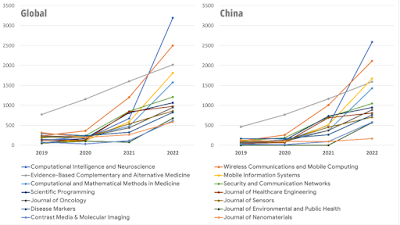 |
| Figure 2. Number of articles and reviews published in 14 Hindawi journals 2019-2022. Data from Scopus. |
It is possible that mass retractions were delayed because Wiley did not want to disrupt their agenda at the 74th Frankfurter Buchmesse (October 19 to 23, 2022). There was no indication that Wiley shared Hindawi's problems at the book fair. Instead, they were busy with other things. Flynn announced the creation of Wiley Partners Solution to meet the "scholarly publishing needs at scale" on October 17. Ferguson participated in a forum entitled "How the Article-Based Economy is Transforming Research Publishing" on October 19. Intriguingly, an essay posted by Chemistry World on April 24, 2023, citing Flynn, noted that Wiley had convened a meeting of publishers at that book fair, invited Clarivate, the owner of major journal database Web of Science (WoS) Core Collection, and disclosed to them the problems with Hindawi journals. We do not know the outcome of this meeting, but change did occur. On the one hand, Hindawi began issuing retractions on November 16, 2022. Nevertheless, in October 2022, special issues of Hindawi journals were still being published with many compromised articles, though from December 2022 onwards, the number of papers published in special issues decreased.
Delisting of Hindawi journals
The public information prompted journal databases to re-evaluate whether Hindawi journals should continue to be indexed. In February 2023, DOAJ (Directory of Open Access Journals) delisted thirteen Hindawi journals. Then Scopus discontinued the indexing of six Hindawi journals. On March 20, 2023, Clarivate delisted nineteen Hindawi journals from WoS Core Collection. The fact that Education Research International was delisted suggested Clarivate conducted an independent investigation, as this journal had not been mentioned in relevant sources.
As shown in Figure 3, the actions of the publisher and journal databases did not always involve the same journals.
Figure 3. Twenty-six problematic Hindawi journals. WoS Core Collection: The journal was delisted from WoS Core Collection in March 2023. DOAJ: The journal was delisted from DOAJ in February 2023. Scopus: The journal was delisted from Scopus in the first half of 2023. Ferguson 500+: Papers in the journal were retracted and Liz Ferguson's statement was cited in the retraction statement. Flynn 2200+: Papers in the journal were retracted by Wiley using similar statements after May 2023. Clarivate did not publish the reasons for the delisting of each journal, nor did they delist more Hindawi journals before the release of 2023 Journal Citation Reports on June 28, 2023. Compared to MDPI, whose mega-journal the International Journal of Environmental Research and Public Health was delisted, Wiley's public response was subdued. In a mildly worded statement on March 22, 2023, on their WeChat Official Account, Hindawi said they were "disappointed" that their journals were delisted by Clarivate but did not offer any defence. In another post on April 5, 2023, Hindawi stated they would not appeal the delisting and suggested that the authors submit their manuscripts to Wiley journals. A guest post by Flynn in the Scholarly Kitchen on April 4, 2023, mentioned that:
“At Wiley we take full responsibility for the quality of the content we publish across our portfolio.”
He also announced a further 1,200 retractions to be issued by Hindawi journals. Flynn disclosed to Chemistry World how they selected which publications to retract, specifically that he deployed 200 people from his editorial staff to conduct "a manual review of every single paper that we thought may have been compromised'".
Impact on authors
Many authors published in Hindawi journals because they had the cachet of being listed in scholarly databases. One author of an article published in February 2023 in Oxidative Medicine and Cellular Longevity distributed email templates she drafted to others via an instant messaging software, encouraging them to ask Hindawi to work with Clarivate to index papers with publication dates before March 19, 2023. Anonymous sources described the chaos of Hindawi's customer service in late March 2023. Many people complained that Hindawi never responded to their emails. On the other hand, one author received a response from Oxidative Medicine and Cellular Longevity (omcl@hindawi.com), even though his complaint was about an article in another journal. Some authors of accepted manuscripts complained that Hindawi delayed their requests to withdraw their submissions, and feared that manuscripts would be accidentally published.
Other authors turned on the sleuths who had exposed paper mill activity on PubPeer, describing their activities as "social media-related PubPeer extortion". Jincheng Wang from the Nanjing Drum Tower Hospital, who had published in a compromised special issue, suggested that the intent of those who posted comments was to blackmail the authors, under the threat of translating publicly available comments into Chinese and then posting them on social media in China. He encouraged authors to report these comments to the moderators.
Impact of delisting on Hindawi’s business
Wiley did not inform investors about the retractions in Hindawi journals in their 2nd quarter report (August 1 to October 31, 2022) published on December 7, 2022. In the 3rd quarter report (November 1, 2022, to January 31, 2023) on March 9, 2023, Napack confronted the issue head-on:
“Upon discovery, the Wiley team responded quickly, suspending the Hindawi special issues program and fixing the source of the problem by purging the external bad actors and by implementing measures to prevent this from happening again. To date, these actions include increasing editorial controls and introducing new AI-based screening tools into the editorial process. We've also been scrubbing the archive and publicly retracting any compromised articles.”
And,
“We put the fixes in place. We feel very good about what we've done. We are reopening the programs. And we are moving forward to clear the backlog and drive forward with our publishing program.”
However, the statistics on publications showed that publications in special issues continued through November 2022 to January 2023. Despite the claim that the problem had been resolved, more than 200 articles published in special issues of 34 Hindawi journals in 2023 received comments on PubPeer relating to concerns about the publishing process.
The release of retraction statements was also delayed. As of July 20, 2023, retraction statements were issued on six dates, on May 24, June 21, June 28, June 29, July 12, and July 19, with 112, 559, 514, 1, 521, and 510 retractions, respectively. The total number of retracted papers, approximately 2700 including the initial 500 from 2022, substantially exceeds the 1200 mentioned by Flynn.
An interesting development has been the involvement of law firms who specialize in shareholder rights litigation, such as Rosen Law Firm, Kirby McInerney LLP, Schall Law Firm, Glancy Prongay & Murray LLP, the Law Offices of Frank R. Cruz and the Law Offices of Howard G. Smith. All of these firms recently advertised that they are investigating whether Wiley issued misleading information about Hindawi to the investing public.
In the 4th quarterly report for 2023, Napack stated that they had remedied all the problems, and were ready for “revitalization”
“As discussed in Q3, we suspended the fast-growing special issues program after identifying a research integrity issue. This issue was the result of external misconduct by non-Wiley editors and reviewers. Essentially, Wiley decided to take a short-term hit to preserve the integrity of our journals and the value of our highly respected Wiley brand. This industry-wide issue has been widely reported on, and we believe that we now have it fully remediated in Wiley.”
In the same report, Napack was still expressing satisfaction with Hindawi's performance since the acquisition:
“Our expectation for Hindawi was a couple-fold. One, it would accelerate our position in that market, which it has; and that it would provide significant growth, which it has, and it will provide the ability to provide significant cascade across our portfolio that we could find homes for the many hundreds of thousands of articles that we get every year that are not published. Our expectations are the same going forward. We expect that over the next 12 to 18 months, we will be fully ramping back up. So, by '25, we're back on course with our volume growth and it should drop to the bottom line at/or we're close to the margin -- very healthy margin that it always has in our -- across all of our Open Access, but certainly across the Hindawi asset. So, the -- relative to our initial expectations, this acquisition has outperformed if you just can look aside for a minute against a very short-term thing that happened to us. But we're going to lead our way -- lead the industry out of it, and we feel very, very good about the future of our overall Open Access program.”
So the paper mill debacle, which led to thousands of fraudulent papers being published in Hindawi journals over at least two years, is described as “a very short-term thing that happened to us” and is now “fully remediated”, was blamed on “external misconduct by non-Wiley editors and reviewers”. This leaves hanging the question of how those non-Wiley editors and reviewers not only achieved powerful positions determining what was published in Hindawi journals, but also continued to do so long after attention had been drawn to the problem by sleuths.
Regaining the market?
Wiley is a mighty, major international publisher, and they have the potential to achieve a Hindawi revitalization, if revitalization is defined as a significant rebound in the number of papers published in Hindawi journals. The question is, which niche market does Hindawi intend to regain? Are they well-positioned to do so? Do they have any appreciation of the tension between their goal of publishing as much as possible, and the reputational costs of publishing papers that are low-quality at best and fraudulent at worst?
The sleuth Parashorea tomentella described the evolution of the niche of special issues of Hindawi journals after its acquisition in China. There is a highly competitive "first-tier" niche of authors from research universities and institutions, who have many manuscripts. China also has an extended, "second-tier" niche of authors from community colleges, polytechnics, and non-teaching hospitals. There are many, many of these potential customers, but they lack manuscripts on the one hand, and desire publications for promotion on the other. Paper mills fill the need of authors in this niche to publish and the needs of publishers to make money. It would be difficult for Hindawi to regain the first-tier niche, because most authors and institutions care about the reputation of the publisher, and even if they aren’t concerned about integrity they are spooked by unprecedented large-scale retractions.
Hindawi is, however, in a strong position to regain the second-tier niche. First, despite all the problems, they still have many journals that are recognized by the Chinese authorities (typically those listed in databases such as WoS Core Collection and Engineering Village). Wiley has close links with those who maintain databases and may have an advantage in avoiding their journals being blacklisted.
Wiley's longstanding commitment and partnership with Chinese research institutes and government stakeholders has brought them particularly close to the National Science Library, Chinese Academy of Sciences (NSL/CAS), a bureaucracy that compiles a blacklist which is recognized by many Chinese institutions. On June 16, 2023, Wiley and NSL/CAS announced the establishment of a Joint Laboratory on Scientific and Technical Journal Innovation. The press release mentioned that an important topic for the joint lab is research integrity, and Liying Yang, director of journal evaluation in NSL/CAS, introduced what NSL/CAS can do, including updating their Early Warning Journal List, which aimed to target paper mills.
For reasons unknown, NSL/CAS has been particularly kind to Hindawi journals. NSL/CAS released their controversial Early Warning Journal List in December 2020, December 2021 and January 2023. In the latest version, the Hindawi journals Biomed Research International, Complexity, Advances in Civil Engineering, Shock and Vibration, Scientific Programming and Journal of Mathematics, which had been on the blacklist, were reinstated. Other problematic Hindawi journals were never on the blacklist. In contrast, the blacklist compiled by another Chinese bureaucracy, the Institute of Scientific and Technical Information of China (ISTIC), does not show undue goodwill toward Hindawi journals. In January and February 2023, some Chinese institutions, such as Zhejiang Gongshang University and Anhui Provincial Hospital (The First Affiliated Hospital of University of Science and Technology of China), told their employees not to submit to Hindawi journals. NSL/CAS was sending a different signal from other Chinese institutions and encouraged authors to continue submitting to Hindawi journals, although this effect was offset by Clarivate's delisting of nineteen Hindawi journals three months later.
Hindawi’s determination to retain the second-tier niche may explain why they have continued to publish their customers' manuscripts from known paper mills. For instance, an article (now retracted) was published on March 11, 2023, long after the guest editor Kaifa Zhao had been proven to be an impostor. To take another example, the Hindawi Research Integrity Team retracted nine articles from a special issue of BioMed Research International on “Minimally Invasive Treatment Protocols in Clinical Dentistry” between November 22, 2022, and February 14, 2023, but subsequently published new articles in the same special issue on topics out of scope.
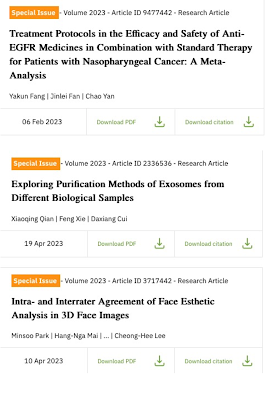 |
| Figure 6. A special issue
(https://www.hindawi.com/journals/bmri/si/652179/ ) of BioMed Research
International published articles on a topic out of scope in between
retraction statements |
Even more alarmingly, special issues of four journals (Computational and Mathematical Methods in Medicine, Journal of Healthcare Engineering, Journal of Environmental and Public Health, and Computational Intelligence and Neuroscience) continued to publish questionable articles after Hindawi announced that the journals had closed on May 2, 2023, see e.g., https://pubpeer.com/publications/1F1263D5537A0EF96588929A60D15B ). In one weird case, an article that had been accepted 604 days previously was published in Journal of Healthcare Engineering on July 7, 2023. Perhaps this manuscript had been blocked by production processes or the Hindawi Research Integrity Team, but it was eventually published after the journal was closed.
Reasons for pessimism
The reason I am pessimistic is that so far Wiley's proposals to improve the publishing process for Hindawi journals have focused on the use of AI-based screening tools. Wiley has not committed to hiring more editors for Hindawi journals. As the number of submissions increases, the situation will only get worse if peer-review processes hosted by guest editors are assigned to overworked in-house editors to oversee.
Wiley still has a chance to fix things. The first thing they should do is stop manuscripts received by external bad actors from continuing to be published. The second is to issue more retractions. I'm glad to see that in June 2023, Catriona MacCallum, the director of Open Science of Hindawi shared their approach to scaling up retractions, including focusing on manipulation of the process rather than author wrongdoing. Publisher retractions are painful for the publisher, journals, and authors, but they are necessary, and there are not enough of them. The third is to investigate the internal bad actors in an open and transparent manner. I would also encourage them to recruit more in-house editors, release the identities of the external bad actors they have found, and document the details of how internal controls failed so lessons can be learned.
Most of us value our reputation for its own sake. As Shakespeare said in Othello:
“Good name in man and woman, dear my lord,
Is the immediate jewel of their souls:
Who steals my purse steals trash; ’tis something, nothing; ’twas mine, ’tis his, and has been slave to thousands;
But he that filches from me my good name
Robs me of that which not enriches him,
And makes me poor indeed”
Indeed, as the Hindawi story shows, for a commercial organization, reputation is not just a desirable feel-good factor – it has huge financial implications. If an academic publisher like Wiley becomes known for boosting their profits by publishing screeds of arrant nonsense, their bottom line will ultimately suffer. Reputable researchers will not want their name associated with a publisher who behaves this way. If Wiley are not willing to control fraud because it is the right thing to do, they should at least recognize the importance of integrity for retaining the confidence of the academic institutions on whom they depend.
Footnote
* The author declares that there is no potential conflict of interest. The author uses a pseudonym because he/she lives in an authoritarian state and fears facing unpredictable political reprisals.


 Posts
Posts


