 |
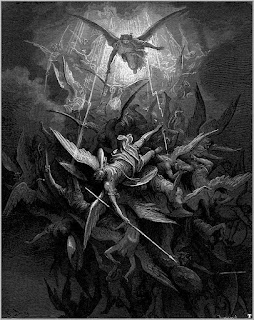
Gustave Doré: Illustration for Paradise Lost
|
(Updated 17 Dec 2022)
As children, we grow up with stories of the battle between
good and evil, but good ultimately triumphs. In adulthood, we know things can
be more complicated: bad people can get into positions of power and make
everyone suffer. And yet, we tell
ourselves, we have a strong legal framework, there are checks and balances, and
a political system aspires to be free and fair.
During the last decade, I started for the first time to have
serious doubts about those assumptions. In both the UK and the US, the same
pattern is seen repeatedly: the media report on a scandal involving the
government or a public figure, there is a brief period of public outrage, but
then things continue as before.
In the UK we have become accustomed to politicians lying to Parliament and failing to correct the record, to bullying by senior politicians,
and to safety regulations being ignored. The current scandal is a case of disaster capitalism where government cronies made vast fortunes from the Covid pandemic by gaining contracts for personal protective equipment – which was
not only provided at inflated prices, but then could not be used as it was
substandard.
These are all shocking stories, but even more shocking is
the lack of any serious consequences for those who are guilty. In the past,
politicians would have resigned for minor peccadilloes, with pressure from the
Prime Minister if need be. During Boris Johnson’s premiership, however, the
Prime Minister was part of the problem.
During the Trump presidency in the US, Sarah Kendzior wrote
about “saviour syndrome” - the belief
people had that someone would come along and put things right.
As she noted: “Mr. Trump has openly committed crimes and even confessed to
crimes: What is at stake is whether anyone would hold him accountable.” And,
sadly, the answer has been no.
No consequences for scientific fraud
So what has this got to do with science? Well, I get the same sinking feeling that
there is a major problem, everyone can see there's a problem, but nobody is going to rescue us. Researchers who
engage in obvious malpractice repeatedly get away with no consequences. This has been a recurring theme from those
who have exposed academic papermills (Byrne et al., 2021) and/or reported
manipulation of figures in journal articles (Bik et al., 2016). For instance, when Bik was interviewed by Nature, she noted that 60-70% of the 800 papers she had reported to journals
had not been dealt with within 5 years.
That matches my more limited experience; if one points out academic malpractice
to publishers or institutions, there is often no reply. Those who do reply typically
say they will investigate, but then you hear no more.
At a recent symposium on Research Integrity at Liverpool
Medical Institution*, David Sanders (Purdue University) told of repeated experiences of being given
the brush-off by journals and institutions when reporting suspect papers. For
instance, he reported an article that had simply recycled a table from a
previous paper on a different topic. The response was “We will look into it”.
“What”, said David incredulously, “is there to look into?”. This is the concern
– that there can be blatant evidence of malpractice within a paper, yet the
complainant is ignored. In this case, nothing happened. There are honorable
exceptions, but it seems shocking that serious and obvious errors in work are
not dealt with in a prompt and professional manner.
At the same seminar, there was a searing presentation by
Peter Wilmshurst, whose experiences of exposing medical fraud by powerful
individuals and organisations have led him to be the subject of numerous libel
complaints. Here are a few details of two
of the cases he presented:
Paolo Macchiarini: Convicted
in 2022 of causing bodily harm with an experimental transplant of a synthetic
windpipe that he performed between 2011-2012.
Wilmshurst noted that the descriptions of the experimental surgery in
journals were incorrect. For a summary see this BMJ article. A 2008 paper by Macchiarini and colleagues is
still published in the Lancet, despite demands for it to be retracted.
Don Poldermans: An eminent cardiologist who conducted a
series of studies on perioperative betablockers, leading them to be recommended
in guidelines from the European Society of Cardiology, whose task force he chaired. A meta-analysis challenged
that conclusion, showing mortality increased; an investigation found that work
by Poldermans had serious integrity problems, and he was fired. Nevertheless,
the papers have not been retracted. Wilmshurst estimated that thousands of deaths
would have resulted from physicians following the guidelines recommending
betablockers.
The week before the Liverpool meeting, there was a session
on Correcting the Record at AIMOS2022. The four speakers, John Loadsman
(anaesthesiology), Ben Mol (Obstetrics and Gynecology), Lisa Parker (Oncology)
and Jana Christopher (image integrity) covered the topic from a range of
different angles, but in every single talk, the message came through loud and
clear: it’s not enough to flag up cases of fraud – you have to then get someone
to act on them, and that is far more difficult than it should be.
And then on the same day as the Liverpool meeting, Le Monde
ran a piece about a researcher whose body of work contained numerous problems:
the same graphs were used across different articles that purported to show
different experiments, and other figures had signs of manipulation. There was an investigation by the institution
and by the funder, Centre National de la Recherche Scientifique (CNRS), which
concluded that there had been several breaches of scientific integrity.
However, it seems that the recommendation was simply that the papers should be
“corrected”.
Why is scientific fraud not taken seriously?
There are several factors that conspire to get scientific
fraud brushed under the carpet.
1.
Accusations of fraud may be unfounded. In
science, as in politics, there may be individuals or organisations who target
people unfairly – either for personal reasons, or because they don’t like their
message. Furthermore, everyone makes mistakes and it would be dangerous to
vilify researchers for honest errors. So it is vital to do due diligence and
establish the facts. In practice, however, this typically means giving the
accused the benefit of the doubt, even when the evidence of misconduct is
strong. While it is not always easy to
demonstrate intent, there are many cases, such as those noted above, where a
pattern of repeated transgressions is evident in published papers – and yet
nothing is done.
2.
Conflict of interest. Institutions may be
reluctant to accept that someone is fraudulent if that person occupies a
high-ranking role in the organisation, especially if they bring in grant income.
Worries about reputational risk also create conflict of interest. The Printeger project
is a set of case studies of individual research misconduct cases, which
illustrates just how inconsistently these are handled in different countries,
especially with regard to transparency vs confidentiality of process. It
concluded “The reflex of research organisations to immediately contain and
preferably minimise misconduct
cases is remarkable”.
3.
Passing the buck. Publishers may be reluctant to
retract papers unless there is an institutional finding of misconduct, even if
there is clear evidence that the published work is wrong. I discussed this
here. My view is that leaving flawed research in
the public record is analogous to a store selling poisoned cookies to customers
– you have a responsibility to correct the record as soon as possible when the evidence is clear to avoid harm to consumers. Funders might be expected to also play a role in correcting the record when research they have funded is shown to be flawed. Where public money is
concerned, funders surely have a moral responsibility to ensure it is not
wasted on fraudulent or sloppy research. Yet in her introduction to the
Liverpool seminar, Patricia Murray noted that the new UK Committee on Research
Integrity (CORI) does not regard investigation of research misconduct as within
its purview.
4.
Concerns about litigation. Organisations often
have concerns that they will be sued if they make investigations of misconduct
public, even if they are confident that misconduct occurred. These concerns are
justified, as can be seen from the lawsuits that most of the sleuths who spoke
at AIMOS and Liverpool have been subjected to. My impression is that, provided there is clear
evidence of misconduct, the fraudsters typically lose libel actions, but I’d be
interested in more information on that point.
Consequences when misconduct goes unpunished
The lack of consequences for misconduct has many corrosive
impacts on society.
1.
Political and scientific institutions can only
operate properly if there is trust. If lack of integrity is seen to be
rewarded, this erodes public confidence.
2. People
depend on us getting things right. We are confronting major challenges to
health and to our environment. If we can’t trust researchers to be honest, then
we all suffer as scientific progress stalls.
Over-hyped findings that make it into the literature can lead subsequent
generations of researchers to waste time pursuing false leads. Ultimately, people are harmed if we don’t fix
fraud.
3.
Misconduct leads to waste of resources. It is
depressing to think of all the research that could have been supported by the
funds that have been spent on fraudulent studies.
4. People
engage in misconduct because in a competitive system, it brings them personal
benefits, in terms of prestige, tenure, power and salary. If the fraudsters are
not tackled, they end up in positions of power, where they will perpetuate a
corrupt system; it is not in their interests to promote those who might challenge
them.
5.
The new generation entering the profession will
become cynical if they see that one needs to behave corruptly in order to
succeed. They are left with the stark choice of joining in the corruption or
leaving the field.
What can be done?
There’s no single solution, but I think
there are several actions that are needed to help clean up the mess.
1.
Appreciate the scale of the problem.
When fraud is talked about in scientific
circles, you typically get the response that “fraud is rare” and “science is
self-correcting”. A hole has been blown
in the first assumption by the emergence of industrial-scale fraud in the form
of academic paper-mills . The large publishers are now worried enough about
this to be taking concerted action to detect papermill activity, and some of
them have engaged in mass retractions of fraudulent work (see, e.g. the case of
IEEE retractions here).
Yet, I have documented on PubPeer numerous new papermill articles in Hindawi special
issues appearing since September of this year, when the publisher announced it would be engaging in retraction of 500 papers.
It’s as if the publisher is trying to clean up with a mop while a fire-hose is
spewing out fraudulent content. This
kind of fraud is different from that reported by Wilmshurst, but it illustrates
just how slow the business of correcting the scientific record can be – even
when the evidence for fraud is unambiguous.
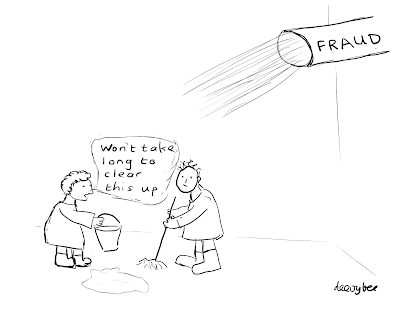 |
Publishers trying to mop up papermill outputs
|
Yes, self-correction will ultimately happen
in science, when people find they cannot replicate the flawed research on which
they try to build. But the time-scale for such self-correction is often far
longer than it needs to be. We have to
understand just how much waste of time and money is caused by reliance on a
passive, natural evolution of self-correction, rather than a more proactive
system to root out fraud.
2.
Full transparency
There’s been a fair bit of debate about
open data, and now it is recognised that we also need open code (scripts to
generate figures etc.) to properly evaluate results. I would go further,
though, and say we also need open peer review. This need not mean that the peer
reviewer is identified, but just that their report is available for others to
read. I have found open peer reviews very useful in identifying papermill products.
3.
Develop shared standards
Organisations such as the Committee on
Publication Ethics (COPE) give recommendations for editors about how to respond when
an accusation of misconduct occurs. Although this looks like a start in
specifying standards to which reputable journals should adhere, several
speakers at the AIMOS meeting suggested that COPE guidelines were not suited
for dealing with papermills and could actually delay and obfuscate
investigations. Furthermore, COPE has no regulatory power and publishers are
under no obligation to follow the guidelines (even if they state they will do
so).
4.
National bodies for promoting scientific
integrity
The Printeger project (cited above) noted
that “A typical reaction of a research organisation facing unfamiliar research
misconduct without appropriate procedures is to set up ad hoc investigative
committees, usually consisting of in-house senior researchers…. Generally, this
does not go well.”
In response to some high-profile cases that
did not go well, some countries have set up national bodies for promoting scientific
integrity. These are growing in number, but those who report cases to them
often complain that they are not much help when fraud is discovered – sometimes
this is because they lack the funding to defend a legal challenge. But, as with
shared standards, this is at least a start, and they may help gather data on
the scale and nature of the problem.
5.
Transparent discussion of breaches of
research integrity
Perhaps the most effective way of
persuading institutions, publishers and funders to act is by publicising when
they have failed to respond adequately to complaints. David Sanders described a case where journals
and institutions took no action despite multiple examples of image manipulation
and plagiarism from one lab. He only got
a response when the case was featured in the New York Times.
Nevertheless, as the Printeger project
noted, relying on the media to highlight fraud is far from ideal – there can a
tendency to sensationalise and simplify the story, with potential for disproportionate
damage to both accused and whistleblowers. If we had trustworthy and official channels to report suspected research misconduct, then whistleblowers would be less likely to seek publicity through other means.
6.
Protect whistleblowers
In her introduction to the Liverpool
Research Integrity seminar, Patricia Murray noted the lack of consistency in
institutional guidelines on research integrity. In some cases, the approach to
whistleblowers seemed hostile, with the guidelines emphasising that they would
be guilty of misconduct if they were found to have made frivolous, vexatious
and/or malicious allegations. This, of course, is fair enough, but it needs to
be countered by recommendations that allow for whistleblowers who are none of
these things, who are doing the institution a service by casting light on
serious problems. Indeed, Prof Murray noted that in her institution, failure
to report an incident that gives reasonable suspicion of research misconduct is
itself regarded as misconduct. At
present, whistleblowers are often treated as nuisances or cranks who need to be
shut down. As was evident from the cases of both Sanders and Wilmshurst, they
are at risk of litigation, and careers may be put in jeopardy if they challenge
senior figures.
7.
Changing the incentive structure in
science
It’s well-appreciated that if you really want
to stop a problem, you should understand what causes it and stop it at source.
People do fraudulent research because the potential benefits are large and the
costs seem negligible. We can change
that balance by, on the one hand having serious and public sanctions for those
who commit fraud, and on the other hand, rewarding scientists who emphasise
integrity, transparency and accuracy in their work, rather than those that get flashy,
eyecatching results.
I'm developing my ideas on this topic and I welcome thoughts on these suggestions. Comments are
moderated and so do not appear immediately, but I will post any that are on
topic and constructive.
Update 17th December 2022
Jennifer Byrne suggested one further recommendation, as follows:
To change the incentive structure in scientific publishing. Journals are presently rewarded for publishing, as publishing drives both income (through subscriptions and/or open access charges) and the journal impact factor. In contrast, journals and publishers do not earn income and are not otherwise rewarded for correcting the literature that they publish. This means that the (seemingly rare) journals that work hard to correct, flag and retract erroneous papers are rewarded identically to journals that appear to do very little. Proactive journals appear to represent a minority, but while there are no incentives for journals to take a proactive approach to published errors and misinformation, it should not be surprising that few journals join their efforts. Until publication and correction are recognized as two sides of the same coin, and valued as such, it seems inevitable that we will see a continued drive towards publishing more and correcting very little, or continuing to value publication quantity over quality.
Bibliography
I'll also add here additional resources. I'm certainly not the first to have made the points in this post, and it may be useful to have other articles gathered together in one place.
Besançon, L., Bik, E., Heathers, J., & Meyerowitz-Katz,
G. (2022). Correction of scientific literature: Too little, too late! PLOS
Biology, 20(3), e3001572. https://doi.org/10.1371/journal.pbio.3001572
Byrne, J. A., Park, Y., Richardson, R. A. K., Pathmendra,
P., Sun, M., & Stoeger, T. (2022). Protection of the human gene research
literature from contract cheating organizations known as research paper mills.
Nucleic Acids Research, gkac1139. https://doi.org/10.1093/nar/gkac1139
Christian, K., Larkins, J., & Doran, M. R. (2022). The
Australian academic STEMM workplace post-COVID: a picture of disarray.
BioRxiv. https://doi.org/10.1101/2022.12.06.519378
Lévy, R. (2022, December 15). Is it somebody else’s problem
to correct the scientific literature? Rapha-z-Lab. https://raphazlab.wordpress.com/2022/12/15/is-it-somebody-elses-problem-to-correct-the-scientific-literature/
Research misconduct: Theory & Pratico – For Better
Science. (n.d.). Retrieved 17 December 2022, from https://forbetterscience.com/2022/08/31/research-misconduct-theory-pratico/
Star marine ecologist committed misconduct, university says. (n.d.). Retrieved 17 December 2022, from https://www.science.org/content/article/star-marine-ecologist-committed-misconduct-university-says
Additions on 18th December: Yet more relevant stuff coming to my attention!
Naudet, Florian (2022) Lecture: Busting two zombie trials in a post-COVID world.
Wilmshurst, Peter (2022) Blog: Has COPE membership become a way for unprincipled journals to buy a fake badge of integrity?
*Addition on 20th December
Liverpool Medical Institution seminar on Research Integrity: The introduction by Patricia Murray, talk by Peter Wilmshurt, and Q&A are now available on Youtube.
And finally....
A couple of sobering thoughts:
Alexander Trevelyan on Twitter noted a great quote from the anonymous @mumumouse (author
of Research misconduct blogpost above): “To imagine what it’s like to be
a whistleblower in the science community, imagine you are trying to report a
Ponzi scheme, but instead of receiving help you are told, nonchalantly, to call
Bernie Madoff, if you wish."
Peter Wilmshurst started his talk
by relaying a conversation with Patricia Murray in the run-up to his talk. He
said he planned to talk about the 3 Fs, fabrication, falsification and honesty.
To which Patricia replied, “There
is no F in honesty”.


 Posts
Posts


