Jo Johnson thinks that the market in Higher Education is unfair. There are currently stringent procedures in place for any institution that wants to award degrees and call itself a University. One facet of this is the requirement that any new provider must initially have its degrees validated by an established University; The University of Suffolk, which gained University title this month, provides an example of how this can work, but many of those seeking to enter the market are unhappy with current arrangements. Roxanne Stockwell, Principal of Pearson College, complained: “Until an institution has its own degree-awarding powers, it cannot offer degrees without being validated by an existing university. Under the current system, a new partner has to find a willing validating partner, and it is locked out if it cannot.”
Jo Johnson, in his role as Minister for Universities and Science last year, criticised this arrangement. He memorably said: “I know some validation relationships work well, but the requirement for new providers to seek out a suitable validating body from amongst the pool of incumbents is quite frankly anti-competitive. It’s akin to Byron Burger having to ask permission of McDonald’s to open up a new restaurant. .....I can announce that we will shortly be lifting the moratorium that has been in place for applications for new Degree Awarding Powers and for University Title. Once again, we are opening the doors to new entrants and challenger institutions, all in the interest of increasing the choices available to students.”
So how wide should the door be opened? This raises deep questions about what constitutes a University. Currently, British Universities have a strong international reputation. Historically, they have been subject to strict scrutiny in return for receiving government funding. They combine research and teaching to push forward the boundaries of knowledge, and have trained students to value knowledge for its own sake, not just as a means to an end.
Not everyone wants that kind of education: some students do not enjoy formal academic study and may prefer vocational courses or apprenticeships. It is important that our higher education system caters for them. The question confronting us now is how far we should extend the definition of a University. It is interesting to consider the Word Cloud I made of ‘alternative providers’, shown in Figure 1.
Let us be clear: the subject matter that these institutions teach is not endorsed by serious scientists. David Colquhoun highlighted a worrying trend for UK Universities to give degrees in ‘anti-science’ back in 2007. In Australia, where chiropractic has been taught within the regular University system, it has come under increasing attack by scientists, who note that by awarding degrees in these subjects, one gives credibility to procedures that are placebos at best and dangerous at worst.
Are these concerns just a sign of anti-competitiveness and elitism? Are scientists trying to squeeze out the alternative providers because they think they’ll poach students from them, just as McDonalds might try to ensure that Byron Burgers are denied space for development? I’d argue not, and furthermore that Jo Johnson’s analogy shows a startling lack of understanding of what a University is all about. Medicine has had many false leads and it would be the height of arrogance to assume that what we know now is the only truth. But the difference between medicine and alternative medicine is not just that there is evidence for effectiveness for medicine; it’s also that in medicine there is a continuous movement to develop and improve theory and practice, rigorously testing and debating ideas and using scientific methods to evaluate them. It’s difficult to do this well and it often goes wrong, but there is broad agreement about the importance of evidence.
Well, you might say, what about religion, another topic that features heavily among alternative providers? Should theology be banned from Universities because it is not evidence-based? The answer is no, and for similar reasons to those given above: the difference between our traditional Universities and the new providers is that Universities teaching theology consider a range of perspectives and teach students critical thinking. You do not need to be a believer in any God to study theology. In contrast, new providers are often narrow in their focus: many of those with religious affiliations look as if they train students in one religious viewpoint and one only.
Defining the difference between what is suitable and not suitable for inclusion in a University degree course is itself an interesting intellectual exercise. We should not assume that something is good just because it already exists, and is bad if it is new. But if we just ignore this distinction and have a free-for-all whereby anything can be regarded as higher education provided that there are students willing to pay for it, we will end up with a system in which the terms University and Degree will count for very little, and where the survival of a higher education institution has more to do with its marketing skills than its academic standing. In the past, there were few institutions clamouring to become Universities because it was not easy to make a profit from Higher Education. That has all changed now that higher education providers can get their hands on money from the Student Loans Company. Experience to date suggests we need to have more, rather than less, scrutiny of alternative providers in the current financial climate.
One final point: the alternative providers I have discussed here could do very well on the Teaching Excellence Framework (TEF), which will rate higher education institutions according to three main criteria: student satisfaction, drop-out rates and employability. Indeed, if they recruit their students from among disadvantaged social groups, they might well achieve higher TEF scores than more selective institutions, because benchmarking is used to adjust the outcomes. So under Jo Johnson’s oversight, we could end up with a situation where the quality of teaching at the Anglo-European College of Chiropractic is deemed superior to that at the Universities of Oxford and Cambridge. An interesting thought.
Saturday, 6 August 2016
Sunday, 17 July 2016
Cost-benefit analysis of the Teaching Excellence Framework
![]() |
| ©CartoonStock.com |
In particular, the report shows that while the costs of TEF to the higher education sector (confusingly described as ‘business’) are estimated at £20 million, the direct benefits will come to £1,146 million, giving a net benefit of £1,126 million (Table 1). How could the introduction of a new bureaucratic evaluation exercise be so remarkably beneficial? I read on with bated breath.
Well, sad to relate, it’s voodoo analysis. This becomes clear if you press on to Table 12, which shows the crucial data from statistical modelling. Quite simply, the TEF generates money for institutions that get a good rating because it allows them to increase fees in line with inflation. Institutions that don’t participate in the TEF, or those that fail to get a good enough rating, will not be able to exceed the current 9K per annum fee, and so in real terms their income will decline over time. As far as I can make out, they are not included in Table 1. Furthermore, the increases for the compliant, successful institutions are measured relative to how they would have done if they had not been allowed to raise fees.
So to sum up:
- You don’t need the TEF to achieve this result. You could get the same outcome by just allowing all institutions to raise fees in line with inflation.
- As noted in the briefing to the Bill by the House of Commons: “the Bill is expected to result in a net financial benefit to higher education providers of around £1.1billion a year. This is in very large part due to the higher fees that providers with successful TEF outcomes will be able to charge students.” (p. 59)
- The system is designed for there to be winners and losers, and the losers will inevitably see their real income falling further and further behind the winners, unless inflation is zero.
Another option, which was strongly recommended by many of those who responded to the consultation exercise on the Green Paper which preceded the bill, is to remove the link between TEF and fees. In other words, have some kind of teaching evaluation, where the motivation for taking part would be reputational rather than financial. This too is rejected as not sufficiently powerful an incentive: “the Research Excellence Framework allocates £1.5bn a year to institutions. To achieve parity of esteem and focus between teaching and research the TEF will need to have a similar level of financial implications.” However, this is rather disingenuous. There is no pot of money on offer. We live in a country where we are used to government supporting Higher Education; now, however, the only source of income to universities for teaching is via student fees, but raising fees is unpopular. The funding of universities will collapse unless they can either find alternative sources of income, or continue to raise fees in line with inflation, and TEF provides a cover story for doing that.
So we have a system designed to separate winners and losers, but the outcome will depend crucially on two factors: the rate of inflation and the rate of increase in students. The figures in the document have been modelled assuming that the number of students at English Higher Education Institutions will increase at a rate of around 2 per cent per annum (Table 12), and that annual inflation will be around 3 per cent. If either growth in numbers or inflation is lower, then the difference between those who do and don’t get good TEF ratings (and hence the apparent financial benefits of TEF) will decline.
What about the anticipated costs of the TEF? We are told: “Institutions collectively will experience average annual costs of £22m as a result of familiarising, signing up and applying to the Teaching Excellence Framework, once the TEF covers discipline level assessments. This is equivalent to an average of £53,000 per institution, significantly less than the Research Excellence Framework (REF) at £230,000 per institution per year.” (p. 8). One can only assume that those writing this report have little experience of how academic institutions operate. For instance, they say that “Year One will not represent any additional administrative cost to institutions, as we will use the existing QA process.” I did a quick internet search and immediately found two universities who were advertising now for administrators to work on preparing for the TEF (on salaries of around £30-40K), as well as a consultancy agency that was touting for custom by noting the importance of being “TEF-ready”.
I have yet to get on to the section on costs and benefits of opening the market to ‘alternative providers’…..
If you are concerned at the threats to Higher Education posed by the Bill, please write to your MP - there is a website here that makes it very easy to do so.
Further background reading
Shaky foundations of the TEF
A lamentable performance by Jo Johnson
More misrepresentation in the Green Paper
The Green Paper’s level playing field risks becoming a morass
NSS and teaching excellence: wrong measure, wrongly analysed
The Higher Education and Research Bill: What's changing?
CDBU's response to the Green Paper
The Alternative White Paper
Saturday, 11 June 2016
Editorial integrity: Publishers on the front line
Thanks to some
live tweeting by Anna Sharman (@sharmanedit), I've become aware that the 13th Conference of the European Association of Science Editors (EASE) is taking
place in Strasbourg this weekend.
The topic is
"Scientific integrity: editors on the front line", and the programme
acknowledges Elsevier, who presumably have contributed funding for the
conference.
It therefore
seems timely to give a brief update of developments following three blogposts I
wrote during February-March 2015, documenting some peculiar editorial behaviour
at four journals: Research in Autism Spectrum Disorders (RASD: Elsevier),
Research in Developmental Disabilities (RIDD: Elsevier), Developmental Neurorehabilitation
(DN: Informa Healthcare) and Journal of Developmental and Physical Disabilities
(JDPD: Springer).
To do the story
full justice, you need to read these blogposts, but in brief, blogpost 1
described how Johnny Matson, the then editor of both RASD and RIDD had
published numerous articles in his own journal, and engaged in frequent
self-citation, leading to his receiving a 'highly cited' badge from Thomson
Reuters. In the comments on that blogpost, another intriguing factor emerged,
which was Matson's tendency to accept papers with little or no review. This was
denied by Elsevier, despite clear evidence of very short acceptance lags that
were incompatible with review.
Blogpost 2 was
prompted by Matson defending himself against accusations of self-citation by
pointing out that he published in journals that he did not edit. I checked
this out and found he had numerous papers in two other journals: DN and JDPD, and that the median lag between
a paper of his being submitted and accepted in DN was one day. (JDPD does not provide
data on publication lags). I therefore looked at the editors of those journals,
and found that they themselves were publishing remarkable numbers of papers in RASD and
RIDD, again with extremely short publication lags. A trio of editors and editorial
board members (Jeff Sigafoos, Giulio Lancioni and Mark O'Reilly), co-authored no less than 140 papers in RASD and RIDD between
2010 and 2014, typically with acceptance times of less than 2 weeks. Some of
the papers in RIDD were not even in the topic area of developmental
disabilities, but covered neurological conditions acquired in adulthood.
In blogpost 3, I
turned the focus on to the publisher of RASD and RIDD, Elsevier, to query why
they had not done anything about such irregular editorial practices. I did a
further analysis of publication lags in RIDD, showing that they had dropped
precipitately between 2008 and 2012, and that there was a small band of authors
whose prolific papers were published there at amazing speed. I provided all the
statistical data to support my case, including interactive spreadsheets that
made it easy to determine which editors and authors had been benefiting from
the slack editorial standards at these journals.
There was some
interesting fall-out from all of this. The second blogpost drew fire from
supporters of the editors I had "outed", accusing me of bad behaviour
and threatening to complain to my university. Since everything I had said was
backed by evidence, this did not concern me. I received heartfelt messages of support from people who were appalled that a particular approach to autism intervention had been promoted by this group of editors, who were in effect using their status to gain the veneer of scientific credibility for work which was not in fact peer-reviewed. I was also contacted by several
academics telling me that everyone knew this had been going on for years, but nobody had done anything; this level of passivity was surprising given that many were angry that authors had reaped benefits from their staggeringly high publication
rate, while those who were outside the charmed circle were left behind. I was urged to go further and raise my concerns with the universities
employing those who were capitalising on, or engaging in, lax editorial
behaviour. I do, however, have an extremely demanding job and I hoped that I had
done enough by shining a light on dubious practices, and providing the full
datasets that provided evidence. However, I now wonder if I should have been more pro-active.
I wrote to
express my concerns to publishers of all four journals, and had my
correspondence acknowledged. But then? Well, not a lot.
It's clear that
Elsevier has taken some action. Indeed, my first blogpost was prompted by
Michelle Dawson noting on Twitter that the editorial boards of RASD and RIDD
had mysteriously disappeared from the online journals. She had previously noted
Matson's pattern of mega-self-citation, and I had written directly to him,
with copy to the publisher, some months previously to express concern, when I realised that I was
listed as a member of the editorial board of RASD. Elsevier did not acknowledge
my letter, but it is possible that the changes to the editorial boards that they had
started were linked to my concerns.
The first direct
response I had from Elsevier was some weeks after my final blogpost, when they
explained that they were looking into the situation regarding unreviewed
papers, but that this was a huge job and would take a long time. They were
presumably disinclined to rely on the files that I had deposited on Open
Science Framework, which show the identity and submission and acceptance data
for every paper in RASD and RIDD. They
did appoint new editors and a small group of associate editors for both
journals, all with good track records for integrity.
I have heard on
the grapevine that they are now evaluating articles published in those journals
that have been identified as not having undergone peer review; some of those approached to do these
evaluations have mentioned this to me. It's rather unclear how this is going to
work, given that, across the two journals, there are nearly 1000 papers where
the available data indicate a lag from receipt to acceptance of under 2 weeks.
I guess we should be glad that at least the publisher is taking some action,
albeit at a snail's pace, but I am dubious as to whether there will be any retractions.
Meanwhile,
Developmental Neurorehabilitation changed publisher around the time I was
writing, and is now under the care of Taylor and Francis. I wrote to the publisher
explaining my concerns and received a polite reply, but then heard no more. I
note that the Editor in Chief is now Wendy Machalicek, who previously co-edited
the journal with Russell Lang. Lang's doctoral advisor was Mark O'Reilly,
editor of JDPD, and one of the prolific trio who featured in blogpost 2. Lang
himself co-authored 24 papers in RASD and 13 in RIDD, and 35 of these 39 papers
were accepted within 2 weeks of receipt. Machalicek has published 11 papers in
RASD and 5 in RIDD, and 12 of these 16 papers were accepted within 2 weeks of
receipt. She also did her doctorate in
O'Reilly's department, and several of her papers are co-authored with him. In an editorial last year, Lang and
Machalicek announced changes to the journal, some of which seem to be
prompted by a desire to make the reviewing process more rigorous under the new
publisher. However, one change is of particular interest: the scope of the
journal will be broadened to consider "developmental disability from a
lifespan perspective; wherein, it is acknowledged that development occurs
throughout a person's life and a range of injuries, diseases and other
impairments can cause delayed or abnormal development at any stage of
life." That will be good news for Giulio Lancioni, who was previously
publishing papers on coma patients, amyotrophic lateral sclerosis, and
Alzheimer's disease in RIDD. He and his collaborators – Jeff Sigafoos, Mark
O'Reilly, as well as Russell Lang and Johnny Matson – are all current members
of the editorial board of the journal.
It seems to be
business as usual at the Springer title, Journal of Developmental and Physical
Disabilities. Mark O'Reilly is still the editor, with Lang and Sigafoos as
associate editors; Lancioni, Machalicek and Matson are all on the editorial
board. Springer's willingness to turn a blind eye to editors playing the system becomes clear when
one sees that a recent title, "Review Journal of Autism and Developmental
Disorders" has as Editor-in-Chief no less a personage than Johnny Matson.
And, surprise, surprise, the editorial board includes Lang, Sigafoos and
Lancioni.
One of the
overarching problems I uncovered when navigating my way around this situation
was that there is no effective route for a whistleblower who has uncovered
evidence of dubious behaviour by editors. Elsevier has developed a Publishing Ethics Resource Kit but
it is designed to help editors dealing with ethical issues that arise with
authors and reviewers. The general advice if you encounter an ethical problem
is to contact the editor. The Committee on Publication Ethics also issues
guidance, but it is an advisory body with no powers. One would hope that
publishers would act with integrity when a serious problem with an editor is
revealed, but if my experience is anything to go by, they are extremely
reluctant to act and will weave very large carpets to brush the problems under.
Labels:
editors,
Elsevier,
publishers,
publishing ethics,
reviewing,
Springer,
Taylor and Francis
Sunday, 29 May 2016
Ten serendipitous findings in psychology
![]() |
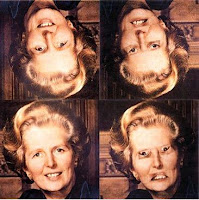
| The Thatcher Illusion (see below) |
But one salient objection to pre-registration comes up time and time again: if we pre-register our studies it will destroy the creative side of doing science, and turn it instead into a dull, robotic, cheerless process. We will have to anticipate what we might find, and close our eyes to what the data tell us.
Now this is both silly and untrue. For a start, there's nobody stopping anyone from doing fairly unstructured exploration, which may be the only sensible approach when entering a completely new area. The main thing in that case is to just be clear that this is what it is, and not to start applying statistical tests to the findings. If a finding has emerged from observing the data, testing it with p-values is statistically illiterate.
Nor is there any prohibition on reporting unexpected findings that emerge in the course of a study. Suppose you do a study with a pre-registered hypothesis and analysis plan, which you adhere to. Meanwhile, a most exciting, unanticipated phenomenon is observed in your experiment. If you are going down the kind of registered reports pathway used in Cortex, you report the planned experiment, and then describe the novel finding in a separate section. Hypothesis-testing and exploration are clearly delineated and no p-values are used for the latter.
In fact, with any new exciting observation, any reputable scientist would take steps to check its repeatability, to explore the conditions under which it emerges, and to attempt to develop a theory that can account for it. In effect, all that has happened is that the 'data have spoken' and suggested a new hypothesis, which could potentially be registered and evaluated in the usual way.
But would there be instances of important findings that would have been lost to history if we started using pre-registration years ago? Because I wanted examples of serendipitous findings to test this point, I asked Twitter, and lo, Twitter delivered some cracking examples. All of these predate by many years the notion of pre-registration, but note that, in all cases, having made the initial unexpected observation – either from unstructured exploratory research, or in the course of investigating something else - the researchers went on to shore up the findings with further, hypothesis-driven experiments. What they did not do is to report just the initial observation, embellished with statistics, and then move on, as if the presence of a low p-value guaranteed the truth of the result.
Here are ten phenomena well-known to psychologists that show how the combination of chance and the prepared mind can lead to important discoveries*. Where I could find one, I cite a primary source, but readers should feel free to contribute further background information.
1. Classical conditioning, Pavlov, 1902.
The conventional account of Pavlov's discovery goes like this: He was a physiologist interested in processes of digestion and was studying the tendency of dogs to salivate when presented with food. He noted that over time, the dogs would salivate when the lab assistant entered the room, even before the food was presented, thus discovering the 'conditioned response': a response that is learned by association. A recent account is here. I was not able to find any confirmation of the serendipitous event in either Pavlov's Nobel speech, or in his Royal Society obituary, so it would be interesting to know if this described anywhere in his own writings or those of his contemporaries.
One thing that I did (serendipitously) discover from the latter source, was this intriguing detail, which makes it clear that Pavlov would never have had any truck with p-values, even if they had been in use in 1902: "He never employed mathematics even in its elementary form. He frequently said that mathematics is all very well but it confuses clear thinking almost to the same extent as statistics."
Suggested by @speech_woman @smomara1 @AglobeAgog
2. Psychotropic drugs, 1950s
Chance appears to have played an important role in the discovery of many psychotropic drugs in the early days of psychopharmacology. For instance, tricyclics were initially used to treat tuberculosis, when it was noticed that there was an unanticipated beneficial effect on mood. Even more striking is Hoffman's first-hand account of discovering the psychotropic effects of LSD, which he had developed as a potential circulatory stimulant. After experiencing strange sensations during a laboratory session, Hoffman returned to test the substances he had been working with, including LSD. "Even the first minimum dose of one quarter of a milligram induced a state of intoxication with very severe psychic disturbances, and this persisted for about 12 hours….This first planned experiment with LSD was a particularly terrifying experience because at the time, I had no means of knowing if I should ever return to everyday reality and be restored to a normal state of consciousness. It was only when I became aware of the gradual reinstatement of the old familiar world of reality that I was able to enjoy this greatly enhanced visionary experience".
Suggested by @ollirobinson @kealyj @neuroraf
3. Orientation-sensitive receptive fields in visual cortex, 1959
In his Nobel speech, David Hubel recounts how he and Torsten Wiesel were trying to plot receptive fields of visual cortex neurons using dots of light projected onto a screen, with only scant success, when they observed a cell that gave a massive response as a slide was inserted, creating a faint but sharp shadow on the retina. As he memorably put it, "over the audiomonitor, the cell went off like a machine gun". This initial observation led to a rich vein of research, but, again to quote from Hubel "It took us months to convince ourselves that we weren’t at the mercy of some optical artefact".
Suggested by: @jpeelle @Anth_McGregor @J_Greenwood @theExtendedLuke @nikuss @sophiescott, @robustgar
4. Right ear advantage in dichotic listening, 1961
Doreen Kimura reported that when groups of digits were played to the two ears simultaneously, more were reported back from the right than the left ear (review here). This method was subsequently used for assessing cerebral lateralisation in neuropsychological patients, and a theory was developed that linked the right ear advantage to cerebral dominance for language. I have not been able to access a published account of the early work, but I recall being told during a visit to the Montreal Neurological Institute that it had taken time for the right ear advantage to be recognised as a real phenomenon and not a consequence of unbalanced headphones. The method of dichotic listening dated back to Broadbent or earlier, but it had originally been used to assess selective attention rather than cerebral lateralisation.
5. Phonological similarity effect in STM, 1964
Conrad and Hull (1964) described what they termed 'acoustic confusions' when people were recalling short sequences of visually-presented letters, i.e. errors tended to involve letters that rhymed with the target letter, such as P, D, or G. In preparation for an article celebrating his 100th birthday, I recently listened to a recording of Conrad describing this early work, and explaining that when such errors were observed with auditory presentation, it was assumed they were due to mishearings. Only after further experiments did it become clear that the phenomenon arose in the course of phonological recoding in short-term memory.
6. Hippocampal place cells, 1971
In his 2014 Nobel lecture, John O'Keefe describes a nice example of unconstrained exploratory research: "… we decided to record from electrodes … as the animal performed simple memory tasks and otherwise went about its daily business. I have to say that at this stage we were very catholic in our approach and expectations and were prepared to see that the cells fire to all types of situations and all types of memories. What we found instead was unexpected and very exciting. Over the course of several months of watching the animals behave while simultaneously listening to and monitoring hippocampal cell activity it became clear that there were two types of cells, the first similar to the one I had originally seen which had as its major correlate some non-specific higher-order aspect of movements, and the second a much more silent type which only sprang into activity at irregular intervals and whose correlate was much more difficult to identify. Looking back at the notes from this period it is clear that there were hints that the animal’s location was important but it was only on a particular day when we were recording from a very clear well isolated cell with a clear correlate that it dawned on me that these cells weren’t particularly interested in what the animal was doing or why it was doing it but rather they were interested in where it was in the environment at the time. The cells were coding for the animal’s location!" Needless to say, once the hypothesis of place cells had been formulated, O'Keefe and colleagues went on to test and develop it in a series of rigorous experiments.
7. McGurk effect, 1976
In a famous paper, McGurk and McDonald reported a dramatic illusion: when watching a talking head, in which repeated utterances of the syllable [ba] are dubbed on to lip movements for [ga], normal adults report hearing [da]. Those who recommended this example to me mentioned that the mismatching of lips and voices arose through a dubbing error, and there was even the idea that a technician was disciplined for mixing up the tapes, but I've not found a source for that story. I noted with interest that the Nature paper reporting the findings does not contain a single p-value.
Suggested by: @criener @neuroconscience @DrMattDavis
8. Thatcher illusion, 1980
Peter Thompson kindly sent me an account of his discovery of the Thatcher Illusion (downloadable from here, p. 921). His goal had been to illustrate how spatial frequency information is used in vision, entailing that viewing the same image close up and at a distance will give very different percepts if low spatial frequencies are manipulated. He decided to illustrate this with pictures of Margaret Thatcher, one of which he doctored to invert the eyes and mouth, creating an impressively hideous image. He went to get sellotape to fix the material in place, but noticed that when he returned, approaching the table from the other side, the doctored images were no longer hideous when inverted. Had he had sellotape to hand, we might never have discovered this wonderful illusion.
Suggested by @J_Greenwood
9. Repetition blindness, 1987
Repetition blindness, described here by Nancy Kanwisher, is the phenomenon whereby people have difficulty detecting repeated words that are presented using rapid serial visual presentation (RSVP) - even when the two occurrences are nonconsecutive and differ in case. I could not find a clear account of the history of the discovery, but it seems that researchers investigating a different problem thought that some stimuli were failing to appear, and then realised these were the repeated ones.
Suggested by @PaulEDux
10. Mirror neurons, 1992
Giacomo Rizzolatti and colleagues were recording from cells in the macaque premotor cortex that responded when the animal reached for food, or bit a peanut. To their surprise, they noticed when testing the animals, the same cell that responded when the monkey picked up a peanut also responded when the experimenter did so (see here for summary). Ultimately, they dubbed these cells 'mirror neurons' because they responded both to the animal's own actions and when the animal observed another performing a similar action. The story that mirror neurons were first identified when they started responding during a coffee break as Rizzolatti picked up his espresso appear to be apocryphal.
Suggested by: @brain_apps @neuroraf @ArranReader @seriousstats @jameskilner @RRocheNeuro
*I picked ones that I deemed the clearest and best-known examples. Many thanks to all the people who suggested others.
Labels:
chance,
exploratory,
hypothesis-testing,
pre-registration,
psychology,
research,
serendipity
Tuesday, 24 May 2016
Who wants the TEF?
I'll say this
for the White Paper on Higher Education "Success
as a Knowledge Economy": it's not as bad as the Green Paper that
preceded it. The Green Paper had me abandoning my Christmas shopping for
furious tirades against the errors and illogicality that were scattered among
the exhausted clichés and management speak (see here, here,
here,
here
and here).
So appalled was I at the shoddy standards evident in the Green Paper that I
actually went through all the sources quoted in the first section of the White
Paper to contact the authors to ask if they were happy with how their work had
been reported. I'm pleased to say that out of 12 responses I got, ten were
entirely satisfied, and one had just a minor quibble. But what about the
twelfth, you ask. What indeed?
When justifying
the need for a Teaching Excellence Framework (TEF) last November, Jo Johnson
used some extremely
dodgy statistical analysis of the National Student Survey to support his
case that teaching in some quarters was 'lamentable'. I was pleased to see that
this reference was expunged from the White Paper. But that left a motheaten
hole in the fabric of the argument: if students aren't dissatisfied, then do we
really need a TEF? One could imagine the
civil servants rushing around desperate to find a suitably negative statistic.
And so they did, citing the 2015 HEPI-HEA Student Academic
Experience Survey as showing that "Many
students are dissatisfied with the provision they receive, with over 60% of
students feeling that all or some elements of their course are worse than
expected and a third of these attributing this to concerns with teaching
quality." (p 8, para 5). The same report is subsequently cited as
showing that: ".. applicants are
currently poorly-informed about the content and teaching structure of courses,
as well as the job prospects they can expect. This can lead to regret: the
recent Higher Education Academy (HEA)–Higher Education Policy Institute (HEPI)
Student Academic Experience Survey found that over one third of undergraduates
in England believe their course represents very poor or poor value for money."
The trouble is, both of these quotes again use spin and dodgy statistics.
Let's take the 60% dissatisfaction statistic first. The executive
summary of the report stated; "Most
students are satisfied with their course, with 87% saying that they are very or
fairly satisfied, and only 12% feeling that their course is worse than they
expected. However, for those students who feel that their course is worse than
expected, or worse in some ways and better than others, the number one reason
is not the number of contact hours, the size of classes or any problems with
feedback but the lack of effort they themselves put in." So how do we
get to 60% dissatisfied? This number is arrived at from the finding that 12% said that their experience had been
worse than expected, 49% said that it had been better in some ways and worse in
others. So it is literally true that there is dissatisfaction with 'some or all
elements', but the presentation of the data is clearly biased to accentuate the
negative. One is reminded of Hugh in 'The Thick of It' saying "I did not
knowingly not tell the truth".
But it gets worse: As pointed out on the Wonkhe
blog, among 'key facts' in a briefing note accompanying the White Paper,
the claim was reworded to say “over 60% of students said they
feel their course is worse than expected”.
The author of the
blogpost referred to this as substantial misrepresentation of the survey. This
is serious because it appears that in order to make a political point, the
government is spreading falsehoods that could cause reputational damage to
Universities.
Moving on to perceptions of 'value for money', there are
two reasons for giving this low ratings
- you are paying a reasonable amount for something of poor quality, or
you are paying an unreasonable amount for something of good quality. Alex
Buckley, one of the authors of the report replied to my query to say that while
the numeric data were presented accurately, crucial context was omitted. This made
it crystal clear it was the money side of the equation that concerned students.
He wrote:
"Figure 11 on page 17 of the 2015 HEPI-HEA
survey report shows that students from England (paying £9k) and students from
Scotland studying in Scotland (paying no fees) have very different perceptions
of value for money. And Figure 12 shows that the perceptions of value for money
of students from England plummeted at the time of the increase in fees. Half of
2nd year students from England in 2013 thought they were getting good or very
good value for money. In 2014, when 2nd years were paying £9k, that figure was
a third. (Other global perceptions of quality - satisfaction etc. - did not
change). There is something troubling about the Government citing students' perceptions
of value for money as a problem for the sector, when they appear to be
substantially determined by Government policy, i.e. the level of fees. The
survey suggests that an easy way to improve students' perceptions of the value
for money of their degree would be to reduce the level of fees - presumably not
the message that the Government is trying to get across."
So do students
want the TEF? All the indicators say no. Chris Havergal wrote yesterday
in the Times Higher about a report by David Greatbatch and Jane Holland in
which students in focus groups gave decidedly lukewarm responses to questions
about the usefulness of TEF. Insofar as anyone wants information about teaching
quality, they want it at the level of courses rather than institutions, but, as
an ONS
interim review pointed out, the data is mostly too sparse to reliably
differentiate among institutions at the subject level. Meanwhile, the NUS has
recommended boycotting
the National Student Survey, which forms a key part of the metrics to be
used by TEF.
This is all rather
rum, given that the government claims its reforms will put
students at the heart of higher education. It seems that they have
underestimated the intelligence of students, who can see through the weasel
words and recognise that the main outcome of all the reforms will be further
increases in fees.
It's widely
anticipated that fees will rise because of the market competition that the
White Paper lauds as a positive stimulus to the sector, and it was clear in the
Green Paper that one goal of the reforms was to tie the TEF to a regulatory mechanism
that would allow higher fees to be set by those with good TEF scores. Perhaps
less widely appreciated is that the plan is for the new Office for Students to
be funded largely by subscriptions paid by Higher Education Providers. They
will have to find the money somewhere, and the obvious way to raise the cash
will be by raising fees. So students will be in the heart of the reforms in the
sense that having already endured dramatic rises in fees and loss of the
maintenance grant, they will now also be picking up the bill for a new
regulatory apparatus whose main function is to satisfy a need for information
that they do not want.
Labels:
Green Paper,
higher education,
misrepresentation,
NSS,
spin,
statistics,
students,
Teaching Quality,
TEF,
TEFoff,
universities,
White paper
Subscribe to:
Posts (Atom)


